

★ ISRAEL
Hostage Crisis Deepens as Israel and Hamas Clash Over Truce
Israel conducted three airstrikes since January 19, despite the cease-fire, citing Hamas threats. A February 28 strike killed a Palestinian in southern Gaza, while Hamas released a March 1 video of hostage Eitan Horn, pleading for his release as his brother prepared to leave captivity. The 42-day cease-fire phase expired March 2, with 24 hostages believed alive. Hamas rejected Israel’s proposed truce extension, demanding a full military withdrawal. Israel, unwilling to commit, proposed exchanging three hostages per week for Palestinian prisoners, but negotiations stalled. Following Hamas’s refusal, Israel suspended all humanitarian aid and closed Gaza border crossings, coordinating with Washington. The U.S. backed Israel’s approach, while Hamas denounced the aid suspension as a violation of international law. Protests erupted in Jerusalem, demanding a renewed truce. Netanyahu’s government defends the pause as security-driven, while Arab states condemn it, Hamas demands withdrawal, and Egypt warns of instability. Meanwhile, Egypt finalized an Arab-led Gaza reconstruction plan, set for a March 4 summit, countering U.S. proposals for territorial control. Foreign Minister Abdel Aati urged the EU to pressure Israel on the cease-fire as Egypt secures international backing. Egypt is spearheading Gaza’s reconstruction with a $53 billion plan, including training Palestinian police for security and governance.
Dimona Espionage Uncovered: Israeli Engineer Indicted for Aiding Iran
Israel indicted Doron Bukhbaza for allegedly offering Iran intelligence on the Dimona reactor. Arrested in a Shin Bet-Lahav 433 operation, the engineer engaged in months-long contact with Iranian operatives, photographing sensitive sites but transmitting only public data. Authorities warn of escalating Iranian espionage targeting Israelis, including reservists.
============
★ SYRIA
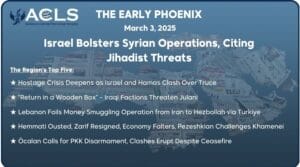
Israel Bolsters Syrian Operations, Citing Jihadist Threats
Israel expands its military presence in Syria, Gaza, and Lebanon, reinforcing deterrence but increasing regional instability. In Syria, the IDF established a buffer zone in December to counter jihadist threats, with U.S. backing minimizing withdrawal pressure. Israeli forces entered Rafeed near Quneitra, searching homes before facing resistance from locals. Protests erupted in Douma and other areas after Israeli airstrikes, with demonstrators calling on rebel leader Abu Mohamad al-Julani, also known as Syria’s de facto president Ahmad Al Sharaa, to retaliate. Netanyahu’s vow to demilitarize southern Syria and protect Druze communities fueled accusations that Israel is stoking sectarian divisions. In Jaramana, clashes between security forces and Druze gunmen followed attacks on a checkpoint, leading to Israeli threats of intervention. Syrian authorities continue security operations against Assad loyalists, with Julani prioritizing nationwide stability. Meanwhile, Syria’s new government banned Hamas and Islamic Jihad from military activity, shutting down Assad-backed centers while recognizing only the PLO and Palestinian Authority as official representatives. Syrian forces also seized a mortar ammunition warehouse in Homs and disrupted a weapons smuggling attempt to Lebanon. Netanyahu’s push aligns with Israeli-Russian discussions aimed at consolidating control over southern Syria while securing Russia’s coastal presence.
Julani Orders, Finalizes Syria’s Transitional Constitution
Abu Mohamad al-Julani, also known as Syria’s de facto president Ahmad Al Sharaa, announced the formation of a legal and political committee to draft a constitutional declaration, marking a step toward Syria’s transitional phase.
President Abu Mohamad al-Julani has appointed a seven-member committee to draft Syria’s transitional charter, now in its final stages. Drawing from the 1950 constitution and regional models, the declaration will define presidential powers, legislative structures, and political regulations. Julani instructed the body to align with national unity while rejecting sectarian quotas. Formed after the February 26 National Dialogue Conference, the committee will submit its draft imminently to be approved by Julani. France has provided legal support. After being excluded from Syria’s National Dialogue Conference, the SDF plans its own talks in northeastern territories. Commander Mazloum Abdi reaffirmed his willingness to join the new Ministry of Defense but only as a unified bloc, a proposal rejected by Damascus, which demands full integration and opposes Kurdish self-rule. Meanwhile, Kurdish leader Abdullah Ocalan’s call for PKK disarmament has sparked debate, with Abdi arguing it would eliminate Türkiye’s justification for military operations against Syrian Kurdish forces.
Julani Pressures Russia for Debt Relief, Assad’s Assets, Reparations
Abu Mohamad al-Julani, also known as Syria’s de facto president Ahmad Al Sharaa, is pressuring Moscow to cancel $23 billion in debt, return Assad’s hidden fortune, and pay $400 billion in war reparations. While not seeking a Russian exit, Damascus aims to revise base agreements signed under Assad. Moscow denies holding Assad’s assets and remains noncommittal on compensation but maintains military activity near Hmeimim and Tartus. Israel is urging the U.S. to back Russia’s presence in Syria to curb Turkish influence and block Islamist factions, as confirmed in a white paper shared with U.S. officials. Meanwhile, Ynet News reported that Washington has provided little clarity on its long-term Syria policy, leaving regional security dynamics uncertain. A Russian analyst suggested the Kremlin may negotiate to balance its strategic foothold against economic strain. Another expert claimed Israel supports Russia’s presence to weaken Damascus while Turkiye expands its influence.
Debate Over Caesar Act: U.S. Sanctions on Syria Face Uncertainty
Maat Zweig confirmed that Donald Trump could suspend the Caesar Act, but only if strict conditions are met. Despite Assad’s fall, legal barriers hinder lifting sanctions, especially with some factions labeled as terrorist organizations. Zweig stressed maintaining pressure for long-term behavioral change, as lifting sanctions alone won’t resolve financial issues. Instead, alternative financial mechanisms are needed to mitigate terrorism financing risks. The U.S. administration is reassessing its stance, balancing economic recovery with counterterrorism measures in post-war Syria.
============
★ IRAQ
“Return in a Wooden Box” – Iraqi Factions Threaten Julani
The Above Authority program on Al Jazeera exposed threats from Iraqi factions against Abu Mohamad al-Julani, also known as Syria’s de facto president Ahmad Al Sharaa, after Nouri al-Maliki refused to meet him. Footage showed Iraqi figures warning Julani against attending the Baghdad Arab Summit, with one threatening he’d “return in a wooden box.” Iraq’s intelligence chief met Julani in Damascus ahead of the summit, while Egypt will host an emergency meeting on March 4 over the Palestinian crisis.
============
★ LEBANON
Lebanon Foils Money Smuggling Operation from Iran to Hezbollah via Turkiye
Lebanese airport security seized $2.5 million in undeclared cash smuggled from Iran to Hezbollah through Turkiye. A Lebanese national was caught at Beirut Airport after meeting an Iranian contact in Istanbul. The operation follows Lebanon’s ban on Iranian civilian flights and stricter inspections on Iraq-bound planes. Authorities suspect Hezbollah sought alternative funding routes after Syrian land routes were restricted. The funds were confiscated under anti-money laundering laws, reinforcing Lebanon’s tightened financial oversight and security measures.
===============
★ IRAN
Iran Escalates Nuclear Threat, Strengthens Military Capabilities
Following the February 8 report by the International Atomic Energy Agency (IAEA) revealing that Iran’s 60% enriched uranium stockpile had surged to 274.4 kg from 182.2 kg three months prior, the Trump administration approved a nearly $3 billion arms deal for Israel, bypassing congressional review, on Saturday. As these critical tensions rise, Iran has unveiled a series of advanced military systems, reinforcing its deterrence posture. The Bavar 373-II air defense system now boasts extended radar detection, autonomous targeting, and an engagement range of 300 km with the integration of Sayyad 4B missiles. The Iranian Navy has expanded its fleet with the Haider 110, a missile-launching fast-attack craft, alongside new warships and heavy naval machinery. Meanwhile, the introduction of the Monir detection system enhances Iran’s ability to counter stealth threats, reflecting Tehran’s focus on asymmetric warfare. Military officials assert that these advancements solidify Iran’s self-reliance in defense, positioning it to confront regional and global adversaries.
Hemmati Ousted, Zarif Resigns, Economy Falters, Pezeshkian Challenges Khamenei
Iran’s parliament dismissed Economy Minister Abdolnaser Hemmati over surging inflation, currency devaluation, and rising costs. His removal, just eight months after the government’s formation, led Mohammad Javad Zarif, Vice President for Strategic Affairs, to resign for the second time during Pezeshkian’s government, citing political pressure and dissatisfaction with Hemmati’s removal. The rial has lost over 50% of its value since September, now at 940,000 per U.S. dollar. Inflation remains near 40%, while wages lag, pushing 30% of Iranians below the poverty line. Household costs surged up to 360% in key cities, with food and rent becoming unaffordable. Hemmati defended his record, citing tax revenue increases, but lawmakers blamed him for economic mismanagement. His removal briefly boosted markets, yet analysts warn that without structural reforms or sanctions relief, economic instability will persist. President Masoud Pezeshkian acknowledged his government’s failure in managing the energy crisis, with blackouts disrupting schools and offices. In a rare indirect challenge to Khamenei, he stressed the need to reassess Iran’s approach, stating,“I believed dialogue was best, but when the Supreme Leader ruled out negotiations, I complied. Still, we must evaluate our path and address the crisis as necessity dictates.”
Iran Exploits Trump-Zelensky Clash to Justify Anti-U.S. Stance
Iran’s Supreme Leader Ali Khamenei and hardliners seized on the heated Oval Office confrontation between Donald Trump and Volodymyr Zelensky to reinforce Tehran’s opposition to U.S. negotiations. Khamenei’s office reposted his 2022 warning that relying on the West is a “mirage,” while Tehran’s streets displayed banners condemning Ukraine’s trust in Washington. The IRGC navy chief cited the clash as proof of U.S. betrayal, asserting that Iran must be self-reliant. Meanwhile, an Iranian establishment paper praised Zelensky for resisting U.S. pressure, arguing that negotiations do not always require concessions. The incident bolstered Khamenei’s recent declaration that talks with the Trump administration would be neither “wise nor dignified.”
===============
★ TURKIYE
Öcalan Calls for PKK Disarmament, Clashes Erupt Despite Ceasefire
On February 27, Abdullah Öcalan, the imprisoned PKK leader, called for the group to disarm and dissolve, seeking to end a 40-year conflict with Turkiye. Within 24 hours, Turkish forces clashed with PKK militants on Mount Metin in Duhok on February 28, exchanging fire with light and medium weapons. A Turkish helicopter bombed Mount Linki in Amedi district, prompting a 45-minute PKK response. As violence escalated, the PKK declared a ceasefire on March 1, pledging to halt attacks unless provoked. Turkish President Erdoğan acknowledged the move but warned military operations would continue if the PKK failed to fully disarm. With Turkish airstrikes persisting in Iraq’s Kurdistan region, the durability of the ceasefire remains uncertain.
Ankara Hosts Turkish-British Talks on Syria’s Future Trajectory
Turkish and British officials will convene in Ankara on March 3 for high-level discussions on Syria’s security and economic landscape. The meeting, led by Turkish Deputy Foreign Minister Nuh Yilmaz and British Minister of State Hamish Falconer, will focus on stabilizing Syria and reinforcing regional security. Turkiye, a key actor in Syria’s transition, has strengthened ties with the new administration and committed to aiding reconstruction and governance efforts. Ankara is expected to advocate for lifting international sanctions to accelerate Syria’s economic recovery while emphasizing the need to curb Israeli incursions that violate Syrian sovereignty.============