

★ISRAEL
Israeli Strike In Doha Targets Senior Hamas Leadership Compound
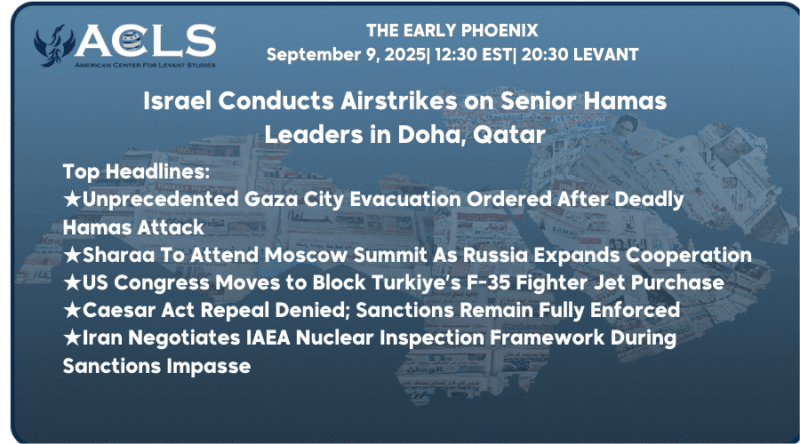
On September 9, Israel launched Operation Summit of Fire in Doha, hours after Hamas attacks in Jerusalem and Gaza killed ten Israelis. Prime Minister Benjamin Netanyahu and Defense Minister Israel Katz ordered the strike, executed solely by the IDF and Shin Bet, with U.S. President Trump aware in advance. Explosions near the Legtifya petrol station struck a Qatari-guarded compound where Hamas leaders—including Khalil al-Hayya, Khaled Mashal, Zaher Jabarin, Nizar Awadallah, Tahir Nunu, Husam Badran, Mohammad Darwish, and Mousa Abu Marzouk—were reportedly meeting to discuss a U.S.-brokered ceasefire proposal. Hamas sources claim senior leaders survived but confirm the deaths of al-Hayya’s son Humam, his office chief Jihad Labad, and three escorts, with al-Hayya’s wife and daughter-in-law injured. Israeli officials expressed optimism key figures were hit, while Israeli politicians hailed the operation as historic deterrence. Qatar and Arab states condemned the strike, which showcased Israel’s capacity to target Hamas command even under foreign protection.
Unprecedented Gaza City Evacuation Ordered After Deadly Hamas Attack
A deadly attack by Hamas militants near Gaza City on September 8 killed four Israeli soldiers, escalating conflict as Israel prepares for a major ground invasion. The militants ambushed an Israeli tank, killing the crew in a rare, direct assault. In response, the Israeli military issued an unprecedented order for the immediate evacuation of all Gaza City civilians ahead of a planned ground offensive. Despite warnings, many Palestinians resist evacuation fearing no safe refuge, while the Israeli Defense Minister threatens to raze Gaza if Hamas does not disarm and free long-held hostages.
Israel Accepts Trump Ceasefire Proposal, War Could End Tomorrow
Israeli Foreign Minister Gideon Sa’ar confirmed Israel’s acceptance of U.S. President Donald Trump’s ceasefire and hostage release proposal. The plan requires Hamas to immediately release all Israeli hostages and disarm. Israel’s cabinet has approved the deal, signaling readiness to end the conflict if Hamas complies. The agreement includes a gradual Israeli withdrawal and negotiations on Gaza governance and disarmament. Sa’ar emphasized that the war “can end tomorrow” if conditions are met, reflecting Israel’s diplomatic openness alongside ongoing military operations.
============
★IRAN
Iran Negotiates IAEA Nuclear Inspection Framework During Sanctions Impasse
Iran’s Foreign Minister Abbas Araghchi met IAEA Director General Rafael Grossi in Cairo to finalize a new cooperation framework after Iran halted nuclear inspections following US-Israeli airstrikes on its facilities. Iran demands guarantees on nuclear site security before resuming inspections while Western powers press for verification while looming UN sanctions snapback. Iran has engaged Qatari mediation, signaling openness to discuss enriched uranium stockpiles. Meanwhile, the UN Security Council, led by South Korea, is split between Western-backed sanctions reimposition and Russia-China efforts for extended negotiation, with a vote due late September unlikely to pass given geopolitical divisions.
Khamenei Assassination Warning Raises Iran-Israel War Risk
Hamzeh Safavi, son of Supreme Leader Ali Khamenei’s military adviser, warned Israel may attempt to assassinate Khamenei independently of U.S. approval, risking full-scale conflict. Safavi highlighted Israel’s willingness to act at “any cost,” including war, while stating the worst outcome could be Iran’s gradual erosion if it fails to respond decisively.
Iran Offers to Develop Iraqi Gas Fields
Iraq faces a power crisis with domestic gas production at 82 million cubic feet per day, short of the 131 million needed, and imports about 50 million cubic feet daily from Iran. Iranian Deputy Oil Minister Hossein Zadeh said Iran is ready to develop gas fields inside Iraq to support the Iraqi National Gas Company, contingent on Baghdad’s decision due to international pressures. Iraq plans to improve infrastructure, including a liquefied natural gas platform at Grand Faw Port and a floating platform at Khor Al-Zubair connected by pipeline to the national grid, aiming for reliable gas delivery.
============
SYRIA
Sharaa To Attend Moscow Summit As Russia Expands Cooperation
Russian Deputy Prime Minister Alexander Novak visited Damascus to advance energy, defense, and political coordination with Syria’s new government, highlighting Moscow’s intent to rebuild Syrian infrastructure and secure a strategic foothold after Assad’s ouster. Damascus confirmed President Ahmad Al Sharaa will attend the Russia-Arab Summit in Moscow on October 15, marking his first major international appearance and signaling Syria’s alignment with Russian-led initiatives. Novak described Sharaa’s participation as the start of a historic phase in bilateral relations, with cooperation spanning oil, power, and military support. This partnership underscores Russia’s bid to consolidate influence in post-war Syria while strengthening Sharaa’s legitimacy, a development that risks deepening Russian entrenchment across Israel’s northern front.
Caesar Act Repeal Denied; Sanctions Remain Fully Enforced
The U.S. House has denied the repeal effort of the Caesar Syria Civilian Protection Act, leaving sanctions fully in place. The repeal bill, H.R. 3941 introduced in June 2025, was not advanced in the defense budget package and remains blocked in committee. A parallel Senate initiative introduced days later has also stalled. As a result, the Caesar Act continues to impose sweeping sanctions on Syria, restricting reconstruction projects and foreign investment.
Turkish-Syrian Defense Pact, Equip, Train, and Modernize
A top Syrian military delegation visited Turkiye where Ankara announced a defense agreement to equip, train, and modernize Syria’s interim forces following Assad’s removal. The pact includes supplying weapons, logistical materials, and technical advisors, alongside joint programs in counterterrorism, cyber defense, demining, and engineering. Intelligence sharing and institutional cooperation will be active as well.
Israeli Strike in Syria Targeted Turkish-Supplied Weapons Depots
Israeli warplanes struck military sites near Homs, Latakia, and Palmyra on September 8, destroying missile depots and air defense systems recently transferred from Turkiye. Reports say the warehouses included Turkish-made missile and air defense batteries. The source accused Turkiye of attempts to provoke a military confrontation, which Israel does not desire but is prepared for. The strikes continue Israel’s campaign against Syrian military infrastructure despite ongoing US-mediated de-escalation talks between Israel and Syria after the Assad regime’s ouster in December 2024.
========
LEBANON
Israel Launches Deadliest Bekaa Airstrikes Since Ceasefire: 5 Hezbollah Killed
Israeli airstrikes on Lebanon’s Bekaa Valley and Hermel killed five Hezbollah members and wounded five others, marking the fiercest Israeli operation since the November 2024 ceasefire. The strikes targeted Hezbollah training camps and weapons depots used for attacks on Israel. Lebanese President Michel Aoun condemned the raids as violations of the ceasefire. The US hasn’t issued an official response but increased pressure on Lebanon to disarm Hezbollah.
Israel Builds New Military Training Site in Golan Simulating Lebanon
Israel opened “Lebanon Facility” in the Golan Heights, a complex designed to simulate combat in southern Lebanon’s urban and mountainous terrain. The site includes multi-story buildings, tunnels, narrow streets, destroyed areas, and Lebanese-style homes for live-fire exercises involving infantry, armor, engineers, and commandos. Dozens of cameras and recording devices allow detailed performance review.
=========
TURKIYE
Turkiye Opposition Uses Furniture to Block Police at CHP Headquarters
In Istanbul, supporters of the main opposition Republican People’s Party (CHP) piled tables and chairs at the entrance of their provincial office to prevent police from enforcing a court order that ousted the CHP’s local leadership last week. The move follows a year-long crackdown against President Erdogan’s rivals, including the arrest of Istanbul Mayor Ekrem Imamoglu. Police used pepper spray and riot tactics to press forward, while CHP called the police blockade a “siege” and urged protests despite a temporary ban on public gatherings. Social media restrictions followed as tensions escalated around the contested leadership change.
US Congress Moves to Block Turkiye’s F-35 Fighter Jet Purchase
A bipartisan group in the US Congress is advancing amendments to the 2026 National Defense Authorization Act (NDAA) that could permanently ban Turkiye from acquiring F-35 stealth fighters unless Ankara meets strict conditions. The key demands include expelling Hamas leadership and halting support to the group, ending military cooperation with Russia, China, Iran, and North Korea, especially drone sales, and ceasing threats against Israel. The legislation also links arms sales to Turkish behavior in Cyprus and requires disclosure of US-origin systems’ usage. Turkiye’s 2019 purchase of Russia’s S-400 missile system triggered Washington’s removal of Ankara from the F-35 program. Despite Turkiye’s attempts to rejoin, Congress insists on firm guarantees first. Israeli Prime Minister Netanyahu has lobbied to keep Turkiye barred. Meanwhile, Ankara is pursuing European fighter deals and advancing its indigenous fifth-generation fighter program for strategic autonomy.
========
THE GULF
India and Qatar to Finalize Trade Agreement Terms in October
India plans to finalize terms for a major trade deal with Qatar in early October, with Commerce Minister Piyush Goyal scheduled to visit Qatar on October 6 to complete negotiations. The deal aims to double bilateral trade to $28 billion over five years. Qatar committed $10 billion in investments focusing on infrastructure, technology, manufacturing, food security, logistics, and hospitality. In FY 2024-25, India-Qatar trade hit $14.2 billion, with India exporting $1.7 billion and importing $12.5 billion from Qatar, which supplies LNG, chemicals, and petrochemicals. The agreement, part of a broader strategy amid rising US tariffs, seeks to expand India’s market diversification and strengthen energy ties.
==================
★ Disclaimer: The Early Phoenix is a digest of various news sources compiled by the Early Phoenix team and edited by Rania Kisar. The items are curated, concise summaries of news items hyperlinked within each story. The items and summaries presented do not necessarily represent the views of the American Center for Levant Studies.