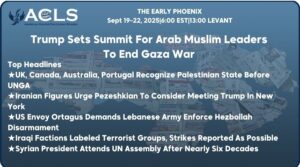
- Trump Sets Summit For Arab Muslim Leaders To End Gaza War
President Trump will meet a select group of Arab and Muslim leaders on September 24, 2025, at the U.N. General Assembly in New York to discuss ending the ongoing Gaza war and post-war stabilization plans. Invited leaders include those from Saudi Arabia, UAE, Qatar, Egypt, Jordan, and Turkey. The White House aims to involve these nations in a stabilization force to replace the Israeli military in Gaza. Arab leaders are expected to press Trump to urge Israeli Prime Minister Netanyahu to cease hostilities and halt West Bank annexation, citing risks to the Abraham Accords. Trump will also hold a separate meeting with Gulf states on the same day to address concerns over Israel’s strike on Hamas leaders in Qatar. This summit precedes Netanyahu’s planned visit to the White House on September 29, underscoring U.S. efforts to manage Middle East conflict and protect key regional alliances.
===========
★ISRAEL
-
UK, Canada, Australia, Portugal Recognize Palestinian State Before UNGA
The UK, Canada, Australia, and Portugal formally recognized a Palestinian state on Sunday, with leaders framing the move as essential to preserving prospects for a two-state solution; Israeli officials denounced the decision as a “reward for terrorism,” and announced possible West Bank annexation. Hamas praised the recognition as “an important step.” France tied embassy opening to Hamas freeing hostages, as Paris and Riyadh prepare a UN summit on Palestinian statehood.
-
Israel Says ~20 Hostages Alive Despite Conflicting Claims About Higher Death Toll
Israel currently reports that 20 of the 48 hostages remaining in Gaza are still alive. Various other figures—such as President Trump’s claim that “very close to 40” are dead—are unverified by official sources.
-
Israeli Opposition Leaders Establish Forum, Seek Gantz And Bennett
Opposition leaders Yair Lapid, Avigdor Liberman, Gadi Eisenkot, and Yair Golan formed a permanent forum September 20 to coordinate governance plans, including constitutional principles, universal service enforcement, and preserving Israel’s Jewish and democratic character; they urged Naftali Bennett and Benny Gantz to join after Yom Kippur, though both were absent, with Bennett citing a family memorial and Gantz keeping distance, as the bloc challenges Netanyahu’s coalition.
-
Israel Deployed Operatives Into Iran As Trump Ordered Strikes
Israeli Channel 13 reports that 100 operatives infiltrated Iran during June’s 12-day war to disable missile launchers and air defense systems, with discussions extending to potentially targeting Iran’s supreme leader, while on Saturday President Trump declared U.S. forces destroyed Iran’s enriched uranium stockpiles in a long-range bombing raid, praising pilots who trained for two decades and stating Iran’s nuclear program was “totally annihilated.” The IRGC meanwhile announced this Monday that any renewed U.S. or Israeli aggression would be met with decisive retaliation, citing June’s Operation True Promise III missile strikes.
===========
★IRAN
-
Iranian Figures Urge Pezeshkian To Consider Meeting Trump In New York
Former MP Ali Motahari publicly urged President Masoud Pezeshkian to accept potential talks with Donald Trump during the UN General Assembly in New York, arguing Trump’s personality cult could benefit Iran, while reformist politician Gholam-Hossein Karbaschi called on Pezeshkian to obtain Supreme Leader Ali Khamenei’s permission for such a meeting, highlighting internal voices promoting possible U.S.–Iran engagement through public appeals rather than official parliamentary action.
-
Iran Offers Nuclear Roadmap As Araghchi Denies Direct U.S. Talks
Amwaj.media reports that FM Abbas Araghchi submitted a nuclear roadmap to U.S. envoy Steve Witkoff on Sept. 16, but on Saturday Araghchi told IRGC-linked Tasnim News “no direct contact or dialogue” occurred, stressing that U.S. messages are only exchanged indirectly or through intermediaries. The roadmap seeks interim talks, uranium stockpile dilution, and phased sanctions relief tied to U.S. guarantees.
===========
★LEBANON
-
US Envoy Ortagus Demands Lebanese Army Enforce Hezbollah Disarmament
U.S. envoy Morgan Ortagus visited Lebanon this weekend to urge the army to speed up its Hezbollah disarmament plan north and south of the Litani River. On September 21, she met in Naqoura with the ceasefire monitoring committee, comprising France, the U.S., Lebanon, Israel, and UNIFIL. She is set to review the army’s plan, assess resource needs, and follow up on $117 million in pledged U.S. assistance.
===========
★IRAQ
-
UAE’s Dragon Oil Signs Energy Cooperation MoUs In Iraq
UAE-based Dragon Oil, a subsidiary of Emirates National Oil Company, signed new memoranda of understanding with Anton Oilfield Services and Iraq’s Nohadh Al-Benaa, covering oilfield services and contracting. Earlier, it signed with Sahool Al-Salam Oil Services for engineering, procurement, and potential oilfield investment. Dragon Oil, present in Iraq since 2013, said the agreements strengthen cooperation, expand infrastructure, and underscore its long-term commitment to Iraq’s energy sector.
-
Iraqi Factions Labeled Terrorist Groups, Strikes Reported As Possible
Al-Mustaqilla reports four Iraqi factions were recently placed on international terrorist lists, raising the prospect of U.S.-Israeli military action. A source said the designations add pressure on armed groups Washington and Tel Aviv view as regional threats. The move coincides with election delays under consideration, amid political tensions and security risks that could destabilize Iraq’s fragile political reform process.
==========
★SYRIA
-
Syrian President Attends UN Assembly After Nearly Six Decades
Syrian President Ahmad al-Sharaa arrived in New York Sunday for the UN General Assembly, marking the first Syrian head of state appearance since 1967, following Bashar al-Assad’s overthrow in December 2024; al-Sharaa is expected to seek sanctions relief and promote ongoing Israel security negotiations, while Damascus prepares indirect parliamentary elections on October 5 after nearly 14 years of civil war. The Syrian Network for Human Rights issued a paper September 20 criticizing Syria’s March 2025 Constitutional Declaration signed by interim President Ahmad al-Sharaa, citing executive dominance, weak judicial independence, and lack of democratic participation.
===========
★ Disclaimer: The Early Phoenix is a digest of various news sources compiled by the Early Phoenix team and edited by Rania Kisar. The items are curated, concise summaries of news items hyperlinked within each story. The items and summaries presented do not necessarily represent the views of the American Center for Levant Studies.