★IRAQ
-
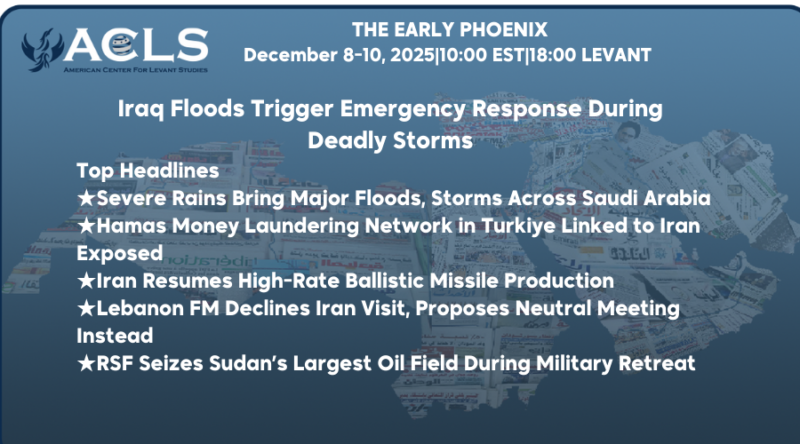
Iraq Floods Trigger Emergency Response During Deadly Storms
Iraq’s northern provinces were hit by sudden flash floods that killed three people—including a child—and injured several others, while damaging homes and blocking key roads. Civil defense teams evacuated dozens of residents and rescued motorists trapped by rising waters. Prime Minister Mohammed Shia al-Sudani ordered air evacuations, rapid road-clearing operations, and urgent bridge repairs. He also launched a forward crisis-management center and allocated emergency relief funds, particularly for the Kurdistan Region. Authorities warned that severe weather will persist, with only brief improvement expected before storms return later in the week.
============
★THE GULF
-
Severe Rains Bring Major Floods, Storms Across Saudi Arabia
Saudi authorities warned of heavy rain causing floods, hail, lightning, poor visibility, and strong winds across the Eastern Province, Hail, Mecca, and Jeddah, where streets and cars were damaged and flights disrupted. Jeddah saw some of the season’s highest rainfall, with storms expected to continue until Thursday as several Arab countries face similar instability.
-
Saudi Arabia, Iran, and China Seek to Expand Political and Economic Cooperation
Saudi Arabia, Iran, and China agreed in a trilateral meeting in Tehran to expand cooperation across economic and political fields, reaffirming their commitment to the Beijing Agreement and regional dialogue. The three urged an immediate halt to Israeli attacks in Palestine, Lebanon, and Syria, welcomed progress in Saudi-Iranian relations, praised China’s supportive role, and backed a UN-led political solution in Yemen.
============
★ISRAEL
-
Hamas Money Laundering Network in Turkiye Linked to Iran Exposed
Israeli authorities revealed that Hamas, directed by Iran, operates a secret network of money exchangers in Turkiye, funneling hundreds of millions of dollars to fund attacks against Israel. Key operatives manage transactions from Iranian sources under Hamas leadership, highlighting the group’s continued efforts to rebuild and finance operations beyond Gaza prompting Israel to reject the proposed two-year disarmament period, and opposing Turkish involvement in a stabilization force.
-
Israel and the United States Launch Annual Intrinsic Defender Naval Drill
Israel and the United States began their “Intrinsic Defender” naval exercise on Sunday, involving dozens of Israeli Navy personnel and the US 5th Fleet to strengthen operational coordination and rehearse responses to regional threats. The joint drill will continue throughout the week.
-
Smotrich Allocates Billions to Build 17 New West Bank Settlements
An Israeli report said Finance Minister Bezalel Smotrich is channeling unprecedented funds—about 2.7 billion shekels—to expand settlement infrastructure, including 17 new settlements, roadworks, land registration, and relocating military bases. The plan strengthens Israeli control beyond the Green Line, prompting Jordan to condemn it as a grave violation of international law.
-
Israeli Shekel Hits Strongest Level Against Dollar in Years
The Israeli shekel reached 3.212 per dollar, its strongest level in over three years, driven by expected U.S. rate cuts, strong markets, improved fiscal data, defense exports, rising foreign venture capital, and investor hedging, as the Bank of Israel set the rate at 3.210. At the same time, Iran’s free‑market rial has collapsed to about 1.24 — 1.25 million per dollar, its weakest level on record, marking a loss of over 90% of its value since the pre‑2018 sanctions period when it traded near 55,000 per dollar.
===========
★IRAN
-
Iran Boosts Hezbollah Through Major Military Reconstruction Funding
Israel’s “Walla News” says Iran has funneled hundreds of millions of dollars to rebuild Hezbollah’s military power, covering salaries, training, rehabilitation, and support for fighters’ families. Israeli intelligence claims Hezbollah has infiltrated Lebanon’s army and continues operating despite airstrikes, focusing on weapons smuggling and expanding underground facilities and new bases.
-
Israeli Sources: Iran Resumes High-Rate Ballistic Missile Production
Israeli officials told a Knesset security committee that Iran has returned to producing ballistic missiles at a high pace, six months after the 12-day conflict. The army representative also said Israel is still drafting a plan to defeat Hamas if the U.S. proposal fails. Reports noted Iran’s recent Gulf drills involving ballistic missiles, cruise missiles, and drones.
=========
★LEBANON
-
Lebanon FM Declines Iran Visit, Proposes Neutral Meeting Instead
Lebanese Foreign Minister Youssef Raji declined Abbas Araghchi’s invitation to visit Tehran, citing unsuitable conditions but affirming openness to dialogue. He urged a meeting in a mutually agreed neutral country and stressed ties must be based on full respect for sovereignty and non-interference, adding that only the Lebanese state may wield arms. Raji said Araghchi remains welcome in Lebanon.
============
★EGYPT
-
Sisi Links Trilateral Meeting to Netanyahu Approving Gas Deal
Egypt’s President Abdel Fattah al-Sisi is conditioning the planned Egypt-US-Israel meeting on Prime Minister Benjamin Netanyahu signing a proposed gas agreement, Ynet reported. Cairo is also reportedly demanding Israel withdraw from the Philadelphi and Netzarim corridors. US officials say the deal could deepen regional cooperation as Washington and Cairo work on advancing the Gaza peace process.
★SUDAN
-
RSF Seizes Sudan’s Largest Oil Field During Military Retreat
Rapid Support Forces captured West Kordofan, including the vital Heglig oil field, after overrunning the army’s 90th Brigade. Government troops and oil workers reportedly withdrew into South Sudan. Heglig, Sudan’s largest field and a key processing hub for South Sudanese exports, is situated in oil- and gold-rich Kordofan, marking a major strategic gain for the RSF.
============
★TURKIYE
-
US, Türkiye Hold ‘Fruitful’ Talks on F-35s, Russian S-400 Exit
The US ambassador to Türkiye said talks on Ankara rejoining the F-35 program are “fruitful,” contingent on Türkiye ending its use of Russia’s S-400 system. Improved Trump-Erdogan ties revived cooperation, with hopes for a breakthrough meeting on both nations’ security needs as Türkiye seeks advanced jets to bolster its air power.
-
Türkiye and Hungary Sign Wide-Ranging Deals to Deepen Partnership
Türkiye and Hungary signed agreements on aviation, security, tech, culture, and education, with President Erdoğan announcing a new $10 billion trade target and expanded cooperation in energy, transport, and defense. The sides launched a joint planning group, advanced joint defense projects, and prepared 28 initiatives for the 2026 Science and Innovation Year while discussing Middle East and Ukraine developments.
-
Türkiye Plans Autonomous System to Counter Drone and Bird Threats
Türkiye unveiled the Savuran Project, an autonomous air-security system integrating detection, identification, tracking, and intervention to protect airports from bird hazards and FPV drones. Transport Minister Abdulkadir Uraloğlu said two specialized drones will be developed: one to non-lethally disperse bird flocks, and another to neutralize FPV drone threats, enhancing civil aviation safety.
============
★ Disclaimer: This publication is a digest of various news sources compiled by the Early Phoenix team and edited by Rania Kisar. The items are curated, concise summaries of news items hyperlinked within each story. The items and summaries presented do not necessarily represent the views of the American Center for Levant Studies.