

★ISRAEL
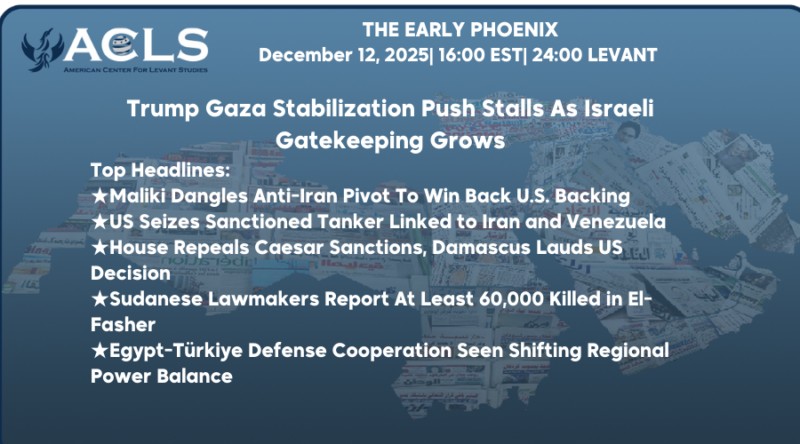
Trump Gaza Stabilization Push Stalls As Israeli Gatekeeping Grows
Trump moves to install a U.S. two‑star general over the Gaza stabilization force as the plan stalls: allies refuse to send troops to forcibly disarm Hamas, Hamas vows only to “store” weapons, and Israel pressures Washington to bar senior European envoys to the Palestinian Authority, while Israel, backed by the U.S., maintains a veto on any Turkish role citing Erdogan’s ties to Hamas and the Muslim Brotherhood, leaving the force without committed contributors and keeping Ankara boxed out of security arrangements on Israel’s southern flank. At the same time, US envoy Tom Barrack said Türkiye should join the planned International Stabilization Force for Gaza, citing its strong ground capabilities and dialogue with Hamas.
Israel Ties Gavili Remains To Ceasefire, Family Rallies Support
Israel rejected Islamic Jihad’s claim it no longer holds hostage remains, linking any move to phase two of the ceasefire to the return of police Master Sgt. Ran Gavili’s body, even as his father told supporters at Tel Aviv’s Hostages Square he cannot accept condolences or speak about his son in the past tense until he sees the body, underscoring continued public pressure on the government to prioritize the remains file alongside the wider truce and accountability debates.
Hamas Offers Weapons Freeze for Long-Term Gaza Truce Deal
Hamas leader Khaled Meshaal told Al Jazeera the group may accept a weapons “freeze” but rejects disarmament required in the US-backed ceasefire plan’s second phase. He said Hamas could store weapons and accept international forces on Gaza’s border, not inside the territory. The fragile truce continues as Israel and Hamas trade accusations of violations.
Taiwan Deputy FM Seeks Israeli Defense Tech Amid China Threat
Taiwan’s Deputy FM Francois Wu made a secret trip to Israel this month eyeing defense cooperation, including potential tech exchanges for Taipei’s T-Dome system modeled on Iron Dome, as both pariahs deepen pragmatic ties against Beijing and Tehran despite lacking formal relations.
Netanyahu Seeks Tighter Control Over October 7 Inquiry
Netanyahu moves to sideline former security chiefs from shaping the October 7 inquiry, portraying their demand for a powerful state commission as a politicized pressure campaign and signaling his intent to keep ultimate control of how systemic failures are investigated and blame is assigned.
Israel Lauds US Defense Bill As Strategic Security Guarantee
Israel lauds the $900 billion US defense bill as a firm guarantee that Washington will sustain its qualitative edge, with $500 million for joint missile defenses plus expanded anti-tunnel, counter‑drone, AI, and cyber cooperation reinforcing Israel’s shield against Iran and its proxies.
===========
★IRAQ
Maliki Dangles Anti-Iran Pivot To Win Back U.S. Backing
As Erbil hosts talks to settle on a “compromise” prime minister empowered to tackle PMF restructuring, budget and debt, KRG salaries, and the US relationship, Nouri al‑Maliki remains both chair of the incoming parliament’s opening session and a fallback candidate if consensus fails—precisely the moment Iraqi leaks say he is privately promising Washington to dismantle Iran‑backed militias, edge toward Abraham‑style normalization, privilege US companies, and sideline faction leaders, an agenda that would gut the Iran‑linked networks underpinning his Bloc and therefore reads less as a realistic program than as a tactical bid to win US tolerance for his return—or that of a handpicked proxy—under a repackaged, ostensibly less pro‑Tehran face.
Barzani Meets Nineveh’s Abdullah al-Yawer On Post-Election Power Plays
KDP leader Masoud Barzani hosted Abdullah Hamidi Ajil al-Yawer—head of the Nineveh for its People Party and a key local Sunni voice from Mosul’s old guard—to discuss Iraq’s post-election landscape, Nineveh governance disputes, and alliance-building amid Baghdad’s maneuvering, underscoring al-Yawer’s enduring role in anchoring Nineveh’s reconstruction and security talks a decade after ISIS.
Norway’s DNO Bets Big On Post‑Restart Kurdistan Volumes
Norway’s DNO is launching its largest Tawke drilling push in over two years, bringing in two high‑capacity rigs to drill eight new wells through 2026 and lift field capacity by roughly 25 percent—around 100,000 barrels per day on top of current output near 80,000 barrels per day under the new Baghdad–KRG–SOMO export mechanism, even after multiple militia drone strikes on the facility.
Iraqi Media Reports Congress Freezes Half Iraq Aid Until Militias Disarmed
Iraqi media reports the 2026 US defense act freezes 50% of US security-cooperation funds for Iraq until Washington certifies Baghdad is verifiably disarming and dismantling Iran-backed militias and bringing all armed formations under the prime minister’s formal chain of command.
==========
★IRAN
US Seizes Sanctioned Tanker Linked to Iran and Venezuela
The United States seized the sanctioned tanker Skipper off Venezuela, with Attorney General Pam Bondi citing its role in an illicit oil network tied to Iran and Hezbollah. President Trump confirmed the raid during a major US military buildup. Venezuela denounced the move as “blatant theft,” while Guyana said the vessel was falsely flying its flag.
Iran Expands Central Asia Corridor To Undercut Western Leverage
Iran is promoting a Kazakhstan–Turkmenistan–Iran trade corridor as a north–south land route funneling Central Asian goods through Iranian territory to global markets, reducing reliance on Western-controlled sea lanes and transit states. The initiative is tied explicitly to “countering Western unilateralism,” signaling Tehran’s intent to turn this corridor into a strategic Eurasian bypass that deepens economic interdependence with non-Western partners and strengthens Iran’s role as a sanctions-resilient transit hub.
=========
★SYRIA
House Repeals Caesar Sanctions, Damascus Lauds US Decision
The US House approved an NDAA provision repealing the 2019 Caesar Syria Civilian Protection Act, which sanctioned the former Assad regime over documented atrocities. Syrian state and regional media reported Damascus secured an unconditional repeal. Images from Damascus, Homs, Hama, Latakia, and Aleppo showed organized celebrations thanking the United States and praising Congress, with activists urging Washington to stay engaged to stabilize the currency, unlock reconstruction financing, and draw new investment flows.
CENTCOM Deepens US–Syria Ties, Reshapes Northern Security Order
Israeli and regional outlets portray CENTCOM’s intensifying coordination with Damascus as the organizing framework for more than 20 monthly joint anti‑ISIS operations on Israel’s northern flank, channeling them into an American‑managed security order that now formally links Syria to Washington’s coalition architecture. At a Washington Syria conference, CENTCOM commander Adm. Brad Cooper framed the planned integration of SDF structures into Syrian state chains of command as a prerequisite for a “predictable and stable” environment, explicitly aligning three U.S. priorities: sustaining aggressive counter‑ISIS operations, managing SDF–regime integration, and expanding direct security coordination with Damascus.
Syria Seizes Captagon Shipment Smuggled Across Border from Lebanon
Syria’s drug control agency said it seized about 400,000 Captagon pills smuggled from Lebanon, confiscating the shipment and the vehicle involved. Authorities, who recently intercepted a record 11 million pills in Homs, are investigating the networks behind the trade. Despite the fall of Assad’s regime, Captagon trafficking persists along the Lebanon-Syria border.
============
★SUDAN
Sudanese Lawmakers Report At Least 60,000 Killed in El-Fasher
British MPs were told at least 60,000 people were killed in recent weeks in Sudan’s El-Fasher after Rapid Support Forces seized the city, with over 150,000 missing. Satellite images show mass graves and widespread destruction, as rights experts call it the war’s worst atrocity. Reports say hundreds, including patients, were executed in local hospitals.
============
★TURKIYE
Egypt-Türkiye Defense Cooperation Seen Shifting Regional Power Balance
Israeli media warned that Egypt’s move to join Türkiye’s KAAN stealth-fighter project could threaten Israel’s future air superiority, while experts said the partnership reshapes regional power dynamics and promotes stability. The cooperation, still under negotiation, would give both states advanced capabilities and reduce reliance on Western suppliers, deepening their fast-improving strategic ties despite longstanding disputes.
============
★ Disclaimer: This publication is a digest of various news sources compiled by the Early Phoenix team and edited by Rania Kisar. The items are curated, concise summaries of news items hyperlinked within each story. The items and summaries presented do not necessarily represent the views of the American Center for Levant Studies.