★ LEBANON
-
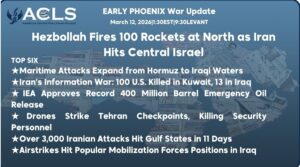
Hezbollah Fires 100 Rockets at North as Iran Hits Central Israel
Hezbollah launched roughly 100 rockets at northern Israel on Wednesday night, causing at least one direct hit and lightly injuring civilians in the Upper Galilee, while separate Iranian missile launches triggered sirens in central Israel and Jerusalem. Israel responded with renewed strikes on Beirut’s Dahiyeh district after issuing evacuation warnings, as Israeli media and officials signaled concern over a broader Hezbollah escalation alongside Iran’s ongoing missile campaign.
=============
★ IRAN
-
Drones Strike Tehran Checkpoints, Killing Security Personnel, Iranian Media Say
Iranian media reported drones struck multiple checkpoints across Tehran on Wednesday evening, killing several security and Basij personnel in what Fars described as the first reported drone attacks over the capital since the war began. An AFP correspondent in northern Tehran heard a drone overhead and several explosions, lending partial independent support to reports that an aerial incident occurred. Iranian outlets attributed the attacks to Israel.
-
Iran Blames Israel, Monarchist Network for Deadly Checkpoint Attacks
Iranian media claimed drones and gunmen attacked multiple security checkpoints across Tehran on Wednesday evening, killing roughly ten security and Basij personnel. Outlets citing “informed sources” alleged the Israeli Mossad coordinated the “terrorist operation” with monarchist groups to infiltrate the capital, with strikes reported near Mahallati Highway, Hashemabad gas station, Fadaeyan‑e Islam Street, and Army Avenue. Authorities reportedly deployed additional security units and said the situation is under control.
-
Iran’s Information War: 100 U.S. Killed in Kuwait, 13 in Iraq
Iran is waging a coordinated information campaign that inflates its capabilities and battlefield success. State outlets tout “secret” 100 m/s underwater missiles, threats to close Hormuz and push oil to $200, and satellite‑driven visibility over US forces to suggest technological superiority and global reach. They also claim a “40th wave,” 50+ targets hit, 100+ US casualties in Kuwait, and 291 Iraqi militia attacks killing 13 Americans, none corroborated by CENTCOM or major Western media, which report limited successful strikes and casualties. Simultaneously, the IRGC Navy declares ships must obtain Iranian approval to transit Hormuz or risk attack, and Quds Force rhetoric vows to “open the gates of fire” so Americans and Israelis are “not safe anywhere in the world, including in their own homes.” Together, these claims function as deterrent signaling rather than reliable battle damage reporting.
-
Iran-Linked Cyber Campaign Expands as Stryker Confirms Global Disruption
Stryker confirmed a globally disruptive cyber incident affecting its Microsoft environment and said it had found no evidence of ransomware or malware. Iran-linked group Handala claimed responsibility and alleged it stole 50 terabytes of data and disrupted operations in 79 countries, but those claims remain unverified. The incident comes amid broader reporting on Iran-linked cyber activity, including MuddyWater intrusions targeting U.S. networks and official warnings of elevated cyber risk to critical infrastructure and regional commercial targets.
-
Projectile Attacks Hit Three Commercial Ships Near Hormuz
Multiple commercial vessels were struck by projectiles in and around the Strait of Hormuz on Wednesday, including the Thai-flagged Mayuree Naree, which caught fire and left three crew missing, along with the One Majesty and Star Gwyneth, which sustained lesser damage. Reuters and other reporting indicate at least 16 ships have been attacked in the Gulf region since the war began.
-
IEA Approves Record 400 Million Barrel Emergency Oil Release
The International Energy Agency’s 32 member states agreed Wednesday to release 400 million barrels from emergency reserves, the largest coordinated stock draw in the agency’s history, to stabilize markets disrupted by the Iran war and threats to Hormuz shipping. Reuters reported the United States would contribute 172 million barrels and Japan 80 million, while the release far exceeds the previous IEA record of 182.7 million barrels in 2022 after Russia’s invasion of Ukraine.
=============
★ GULF STATES
-
UN Security Council Condemns Iran Attacks on Gulf States
The United Nations Security Council passed a 13-0 resolution, led by Bahrain and supported by the GCC, condemning Iran’s missile and drone strikes on Gulf neighbors, including the UAE, Kuwait, Oman, Qatar, Saudi Arabia, and Jordan. The resolution demands Iran halt attacks on civilians and critical infrastructure, including the Strait of Hormuz, and drew record co-sponsorship from 135 member states.
-
Iranian Missile and Drone Attacks Escalate Tensions in the Gulf
Qatari forces intercepted eight ballistic missiles and several drones, while Saudi defenses stopped three ballistic missiles and multiple drones aimed at military bases and oil fields. The UAE condemned the attack on Oman’s Port of Salalah, which damaged fuel storage tanks, and Bahrain reported a strike on a fuel facility in Muharraq, prompting air-raid warnings. Gulf nations have described the assaults as a direct threat to regional security and called on the international community to strongly condemn the attacks.
-
Over 3,000 Iranian Attacks Hit Gulf States in 11 Days
More than 3,000 Iranian missiles and drones struck Gulf countries during 11 days of war, killing 24 people, including seven U.S. soldiers, and injuring 315. According to official data, the United Arab Emirates faced 58% of attacks, followed by Kuwait, Bahrain, Qatar, and Saudi Arabia.
-
Saudi Arabia to Acquire Ukrainian Anti-Drone Technology
Saudi Arabia plans to purchase Ukrainian weapons systems designed to intercept Iranian Shahed drones, amid ongoing attacks across the Gulf. Ukraine, leveraging experience from its war with Russia, has downed over 1,500 UAVs in February alone, and Gulf states, including Qatar, are seeking similar counter-drone support.
=============
★ IRAQ
-
Maritime Attacks Expand from Hormuz to Iraqi Waters
Projectile attacks struck at least three commercial vessels near the Strait of Hormuz on Wednesday, including the Thai-flagged Mayuree Naree, which caught fire and left three crew missing, while One Majesty and Star Gwyneth sustained lesser damage. Hours later, Iraqi authorities said two oil tankers were sabotaged in Iraqi territorial waters, killing one crew member, rescuing 38 others, and leaving additional personnel missing. Reuters says at least 16 ships have been attacked in the Gulf region since the war began.
-
Airstrikes Hit Popular Mobilization Forces Positions in Iraq
Airstrikes targeted Popular Mobilization Forces sites in Al-Qaim and Kirkuk, leaving around 20 people killed or wounded and destroying the 19th Brigade headquarters near the Syrian border. The attacks come amid the ongoing war between Iran, the United States, and Israel, with pro-Iran Iraqi factions repeatedly targeted since late February.
-
Iraqi Militia Threatens Ahmed al-Sharaa with War Over Lebanon
The Islamic Resistance in Iraq warned Syrian President Ahmed al-Sharaa that any hostile military move toward Lebanese territory would be treated as a declaration of war on the entire “axis of resistance,” according to aligned media reports. The statement explicitly threatened regional escalation if Sharaa’s government moved against Hezbollah or supported operations affecting Lebanon, framing such action as a trigger for direct confrontation beyond Syria’s borders. The warning came simultaneously as Sharaa held a conference call with French President Emmanuel Macron and the Lebanese President Joseph Aoun. Local news said Sharaa reaffirmed his support for Lebanon’s stability, state sovereignty and the Lebanese government’s effort to disarm Hezbollah.
=============
★ Disclaimer: This publication is a digest of various news sources compiled by the Early Phoenix team and edited by Rania Kisar. The items are curated, concise summaries of news items hyperlinked within each story. The items and summaries presented do not necessarily represent the views of the American Center for Levant Studies.