★UNITED STATES & ISRAEL
-
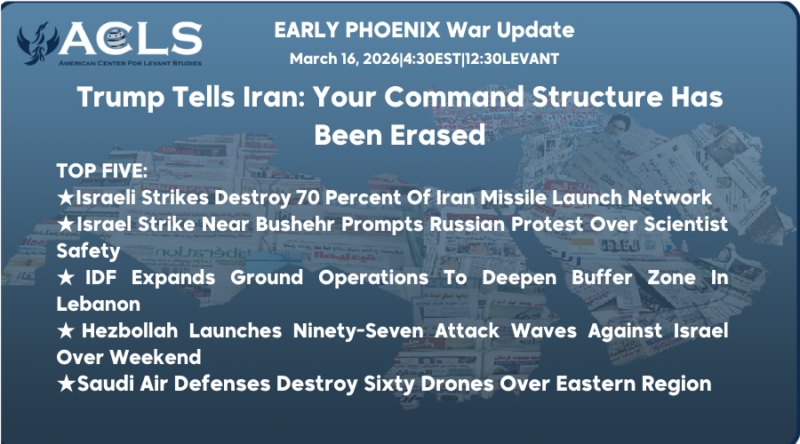
Trump Tells Iran: Your Command Structure Has Been Erased
President Trump said U.S. forces have destroyed Iran’s air force, navy, and most of its air defense network. He said only a small number of launch systems remain and manufacturing capacity has been heavily damaged. He said Iranian drone operations have fallen to about 20 percent of previous levels and that U.S. strikes began yesterday against drone production facilities whose locations are largely known. Trump declined to declare victory, saying Iran has been decimated but the war is not over, and that if the United States withdrew now it would take Iran more than ten years to rebuild its capabilities. He also said U.S. forces struck Kharg Island but deliberately left one section intact where the oil pipelines converge, adding that the remaining facility could be destroyed within five minutes because U.S. forces have it fully targeted and ready, but that he chose not to order the strike yet.
-
Israeli Strikes Destroy 70 Percent Of Iran Missile Launch Network
Israeli forces conducted a major strike wave across Iran on March 13–14 targeting more than 200 military sites including ballistic missile launchers, air defenses, weapons depots, and regime headquarters. Israeli officials say the campaign has destroyed or disabled about 70 percent of Iran’s ballistic-missile launchers. U.S. strikes also hit more than 90 military targets on Kharg Island, a central hub for Iranian oil exports. Journalist Mohamad Ahwaze reported large-scale strikes across Iran including Tehran, Tabriz, Rey, Eslamshahr, Karaj, Khorramabad, Shiraz, and Gohardasht. He said explosions were heard near Mehrabad International Airport in Tehran, with videos showing heavy bombardment in the airport vicinity. The reports were posted on X as strikes were occurring and have not been independently confirmed.
-
Israel Strike Near Bushehr Prompts Russian Protest Over Scientist Safety
Israeli forces struck a target near Iran’s Bushehr nuclear facility where Russian scientists were present. No Russian personnel were injured, but Moscow lodged a formal protest warning Israel against repeated attacks near areas hosting Russian experts. Rosatom previously said about 639 Russian personnel remain in Iran working at the Bushehr nuclear site.
-
Kharg Island Remains Central Hub For Iran Oil Exports
Kharg Island handles about 90 to 96 percent of Iran’s crude exports, roughly 1.5 million barrels daily, and hosts IRGC naval units, missiles, drones, and surveillance near the Strait of Hormuz. Recent U.S. strikes targeted military infrastructure while sparing oil terminals. Separately, Foreign Minister Abbas Araghchi said Israeli strikes on fuel depots in Tehran violated international law and called them “ecocide.”
-
Trump Says Iranian Leadership Decimated, Questions Who Could Negotiate Deal
President Donald Trump said the United States had been communicating with Iran but questioned the value of negotiations, stating Iranian leaders want a deal badly while most of their leadership has already been killed in multiple U.S. strikes. He said the leadership has been “taken out two or three times,” leaving uncertainty about who remains in charge and who the United States could even negotiate with.
-
Trump Says AI-Generated Rally Falsely Portrayed Iranian Regime Popular Support
President Donald Trump said a widely reported rally showing about 250,000 people praising Iran’s leadership said the footage was entirely AI generated. He said U.S. media outlets and foreign organizations circulated the footage despite knowing it was false. Trump said Iranians broadly oppose the current leadership, warned that artificial intelligence can be dangerous in information warfare, and urged greater caution in reporting synthetic media during the conflict.
-
Pezeshkian Warns Macron Iran Will Confront Aggressors
Iranian President Masoud Pezeshkian told French President Emmanuel Macron that Iran will not hesitate to confront aggressors and warned that attacks on Kharg and Abu Musa islands were launched from the territory of Persian Gulf countries, saying states enabling such strikes violate international law and could face consequences. Separately, Foreign Minister Abbas Araqchi told French Foreign Minister Jean-Noël Barrot that countries should adopt a responsible approach and condemn U.S. and Israeli attacks on Iran.
-
Larijani Warns Of Alleged 9/11-Style Plot To Blame Iran
Ali Larijani said what he described as “remnants of the Epstein team” were allegedly planning a September 11 style incident intended to blame Iran. Larijani added that Iran considers itself in a defensive posture against U.S. and Israeli actions and said Tehran remains strong and resolute in punishing aggressors. The remarks came after US media outlets claimed that the FBI had shared intelligence in early February suggesting that if the United States attacked Iran, Tehran might retaliate by launching a drone strike from an unidentified vessel off the California coast.
-
Israel Hayom Expert Warns Of U.S. Threat Like Before 9/11
In an interview with Israel Hayom, counterterrorism advocate Devorah Halberstam warned the United States faces a security climate similar to the period before the September 11 attacks and cautioned that sleeper cells could already be active. She cited a recent attempted truck bombing at Temple Israel in West Bloomfield, Michigan and the arrest of two suspects accused of throwing improvised explosive devices near Gracie Mansion in New York, saying recent attacks on Jewish targets should not be viewed as isolated incidents.
-
IRGC Claims Waves 53 And 54 Strikes Using Multiple Missile Types
Iran’s Islamic Revolutionary Guard Corps said the 53rd and 54th waves of Operation True Promise 4 launched multiple missile types including Sejjil, Khorramshahr, Qadr, Emad, and Khaybar Shekan. Israeli monitoring reported 18 Iranian ballistic missile attack waves over the weekend targeting northern Israel, Tel Aviv, the south, and Jerusalem, indicating a significant decline from the opening days of the conflict.
-
Iran Authorities Launch Nationwide Arrests As Security Crackdown Intensifies
Authorities detained hundreds across provinces including Tehran, Isfahan, Khuzestan, and Yazd as security forces expanded checkpoints, phone searches, and surveillance. Officials accused detainees of propaganda, espionage, and online activity while state media aired forced confessions. Police warned officers were ready to shoot protesters as internet blackouts and arrests of journalists and civilians continued nationwide.
-
Iran Security Forces Accused Of Rape And Torture Of Detained Nurses
Sources told Iran International that Iranian security agents tortured and repeatedly raped two nurses detained after treating wounded protesters during January demonstrations in Tehran. Witnesses said several medical staff who defied orders to deny care were arrested, two nurses were shot and killed, and others disappeared into detention. Amnesty International and the United Nations have warned detainees from the protests face high risks of torture and sexual violence.
-
Iran Military Warns Regional States Supporting Iran International Television Network
Iran’s Khatam al-Anbiya operational command warned regional countries that any media infrastructure supporting the London-based opposition outlet Iran International could be targeted by Iranian forces. The military accused the network of spreading false narratives supporting the United States and Israel and said authorities had arrested at least 18 people accused of sending information and images to the channel.
-
Hamas Secret Letter To Khamenei Jr. Urges Wider War
KAN News reported Hamas sent a secret letter to Iran’s new Supreme Leader Mojtaba Khamenei urging Tehran to activate all fronts against Israel and pledging support from the “resistance axis.” The letter reportedly rejected disarmament and mocked Gulf states that normalized relations with Israel, while a separate public Hamas statement urged Iran not to target neighboring Gulf countries.
===============
★LEBANON
-
IDF Expands Ground Operations To Deepen Buffer Zone In Lebanon
Israeli forces from the 91st “Galilee” Division pushed deeper into southern Lebanon in a raid aimed at expanding a forward defense zone after Hezbollah attacks earlier this month. The IDF said troops killed several Hezbollah operatives during operations in the eastern sector while additional divisions continue raids in other areas of southern Lebanon following airstrikes and artillery strikes on Hezbollah targets. Sources told Haaretz that Israel postponed planned direct talks with Lebanon while reviewing a French proposal linking a cease-fire and partial Israeli withdrawal to potential Lebanese recognition of Israel. Diplomatic sources said France and the United States are discussing a broader framework that could open negotiations and involve regional actors in postwar arrangements and reconstruction efforts.
-
Hezbollah Launches Ninety-Seven Attack Waves Against Israel Over Weekend
Israeli monitoring identified 97 Hezbollah attack waves against Israel during March 13–14, including 82 rocket and missile barrages, 11 UAV attacks, and four anti-tank strikes. March 14 recorded 56 waves, the highest single-day total since the fighting began. Since joining the war on March 2, Hezbollah has conducted 465 attack waves targeting northern Israel, the Galilee, the Golan Heights, and Haifa.
=============
★GULF STATES
-
Saudi Air Defenses Destroy Sixty Drones Over Eastern Region
Saudi Arabia’s Ministry of Defense said air defenses intercepted and destroyed 60 hostile drones targeting the Eastern Region within a four-hour period, according to a statement carried by the state outlet Al-Ekhbariya. The interceptions occurred during continued regional attacks linked to the ongoing Iran-U.S.-Israel conflict and follow earlier reports of multiple drone and missile attempts against Gulf states.
-
Bahrain Arrests Cell Accused Of Spying For Iran IRGC
Bahrain’s Interior Ministry announced the arrest of five suspects and the identification of a sixth fugitive accused of collaborating with Iran’s Islamic Revolutionary Guard Corps. Authorities said the group collected coordinates and sensitive information on vital sites and hotels and passed them to IRGC-linked contacts. Officials said one suspect received training in IRGC camps on smuggling and recruiting operatives for terrorist attacks.
-
Drone Incident Sparks Fuel Tank Fire Near Dubai Airport
Authorities said a drone strike caused a fire near a fuel tank in the vicinity of Dubai International Airport, prompting a temporary suspension of flights before operations resumed on a limited schedule. The UAE Ministry of Defence said air defenses were responding to incoming Iranian missile and drone threats as Dubai Civil Defence teams contained the fire with no injuries reported.
-
Egypt Signals Support For UAE And Qatar After Iranian Attacks
Egyptian President Abdel Fattah el-Sisi told UAE President Sheikh Mohammed bin Zayed that Egypt is ready to support regional stability and condemned Iranian drone and missile attacks on Gulf states. Separately, Egypt’s foreign minister delivered a message from Sisi to Qatar’s Emir Sheikh Tamim bin Hamad Al Thani expressing solidarity with Doha and rejecting what Cairo described as repeated Iranian attacks.
================
★IRAQ
-
Strikes Kill Kataib Hezbollah Members As Drone Hits U.S. Embassy Baghdad
Airstrikes killed three members of the Iran-aligned militia Kataib Hezbollah, including rocket commander Abu Ali al-Aamiri. Shortly afterward, a drone or projectile struck the U.S. Embassy compound in Baghdad’s Green Zone, damaging the helipad and parts of the air-defense system. Iraqi authorities closed the Green Zone following the attack as tensions escalated across militia fronts in Iraq.
-
Rockets Strike Baghdad Airport Complex Near U.S. Facility
Five rockets struck Baghdad International Airport and surrounding facilities including an airbase, water desalination plant, and an area near the Al-Karkh prison holding Islamic State detainees. Iraqi authorities said five people were wounded including airport staff and an engineer. Security forces later discovered a mobile rocket launcher southwest of Baghdad in the Radwaniyah district.
-
Iran Increases Gas Supplies To Iraq After Earlier Disruptions
Iran increased natural gas deliveries to Iraq from six million to 18 million cubic meters per day, according to Iraq’s Ministry of Electricity. Officials said the additional supply was directed to southern regions to stabilize power generation after earlier interruptions that caused losses of up to 4,500 megawatts on Iraq’s electrical grid. Iranian gas provides roughly 30 to 40 percent of fuel for Iraq’s power plants.
=============
★ Disclaimer: This publication is a digest of various news sources compiled by the Early Phoenix team and edited by Rania Kisar. The items are curated, concise summaries of news items hyperlinked within each story. The items and summaries presented do not necessarily represent the views of the American Center for Levant Studies.