★UNITED STATES & ISRAEL
-
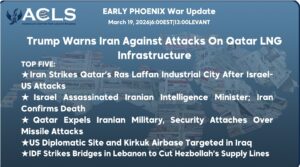
Trump Warns Iran Against Attacks On Qatar LNG Infrastructure
Trump said Israel struck Iran’s South Pars gas field and claimed the United States had no prior knowledge of the attack. He said Iran responded by striking part of Qatar’s LNG infrastructure. Trump warned that if Iran attacks Qatar again, the United States will destroy the South Pars field.
-
Israel Strikes Hundreds of Targets in Iran, Including South Pars Gas Field
Israel launched a major escalation against Iran, attacking over 200 targets in a single day, including missile sites, air defenses, naval bases in the Caspian Sea, and the South Pars gas field in Bushehr. Explosions were reported near Tehran, and Iranian air defenses were activated. Debris from intercepted missiles also hit Ben Gurion Airport, damaging private planes, marking the first impact on Israel’s main airport since the February 28 U.S.-Israeli campaign began.
-
Israel Assassinated Iranian Intelligence Minister; Iran Confirms Death
Israel announced the killing of Iran’s Intelligence Minister Esmail Khatib in a nighttime strike on his Tehran residence, marking a major escalation. Iranian President Masoud Beheshtian confirmed Khatib’s death, along with that of Ali Larijani and Aziz Naserzadeh, calling it a “terrorist act.” Khatib, a hardliner close to former Supreme Leader Ali Khamenei, has led Iran’s intelligence since 2021 and was allegedly responsible for brutal crackdowns on Iranian protestors.
===============
★IRAN
-
Iran Strikes Qatar’s Ras Laffan Industrial City
Iran launched multiple ballistic missiles at Qatar’s Ras Laffan Industrial City in apparent retaliation for a joint US-Israeli strike on Iran’s South Pars gas facility. QatarEnergy reported extensive damage despite some missiles being intercepted. Iran also threatened Saudi Arabia’s Samref Refinery, Jubail Petrochemical Complex, and the UAE’s Al Hosn Gas Field. Qatar and the UAE condemned the attacks, citing threats to global energy security.
-
Russian Intelligence Reportedly Boosts Iran’s Military Capabilities
Russia is expanding cooperation with Iran by sharing satellite imagery and enhancing drone technology, aiding Tehran’s targeting of US forces, reports say. Moscow is also supplying drone parts and tactical guidance, while benefiting economically from the prolonged conflict. US officials, however, downplayed the impact on military operations.
===============
★GULF STATES
-
Qatar Expels Iranian Military, Security Attaches Over Missile Attacks
Qatar declared Iran’s military and security attachés persona non grata, ordering them to leave the country within 24 hours. The move responds to repeated Iranian strikes and threats against Qatar, including missile strikes on Ras Laffan Industrial City and other energy facilities. Doha emphasized that such actions endanger regional security and global energy stability, calling for restraint and de-escalation.
-
Kuwait Foils Hezbollah Cell Planning Attacks on Critical Sites
Kuwait’s security services arrested 10 citizens linked to the banned Hezbollah organization after uncovering plans to target vital national infrastructure. The suspects, trained abroad in weapons and drone use, reportely coordinated with foreign entities to provide target coordinates. Kuwaiti authorities announced the suspects had made detailed confessions. Kuwaiti officials warned of strict measures against anyone threatening Kuwait’s security or cooperating with terrorist groups.
-
Gulf Defenses Thwart Iranian Attacks Across Regional Airspace
Gulf air defenses on Wednesday intercepted Iranian ballistic missiles and drones, with Saudi Arabia destroying 7 missiles and 16 drones in Riyadh, Eastern Province, and Al-Kharj, while Kuwait’s forces neutralized 4 missiles and 23 drones, including 3 outside threat zones without damage. UAE, Qatar, and Bahrain also countered multiple attacks against their airspace and waters, as Saudi Arabia hosted a ministerial meeting to coordinate regional security.
-
Gulf Oil Crisis Deepens as Exports Plunge 60% During Attacks
The Gulf faces one of its worst energy crises in decades, with oil exports dropping 60–70% due to attacks, disrupted shipping, and the effective closure of the Strait of Hormuz, a key route for global oil trade. Saudi Arabia, UAE, Kuwait, Iraq, and Qatar report sharp production cuts, halted shipments, and damaged infrastructure, while gas and petrochemical facilities are targeted, raising global energy prices and threatening long-term supply stability.
================
★IRAQ
-
US Diplomatic Site and Kirkuk Airbase Targeted in Iraq
Alarm sirens sounded near Baghdad International Airport after a U.S. diplomatic facility adjacent to the airport was attacked, presumably by Iran-backed militias. Details on damages or casualties remain unclear as investigations continue. Separately, Kirkuk Airbase was struck by a projectile, causing a fire that was quickly contained. Iraq’s Defense Ministry emphasized the attacks threaten national air capabilities but said no foreign personnel were present.
-
Four Explosions Hit Erbil During Rising Middle East Tensions
Four explosions rocked Erbil, in the Kurdistan region of Iraq, sending smoke over the city hosting a U.S.-led coalition base and a large American consulate. Earlier, a drone was intercepted over a U.S. military base near theErbil airport.
-
Iran Gas Supply to Iraq Halted After Pars Attack
Iranian gas supplies to Iraq stopped after an attack on the South Pars field, causing an immediate loss of 3,200–3,500 megawatts of electricity. Iraq relies heavily on Iranian gas imports. Qatar warned the strike on facilities linked to the field, shared with Iran, marks a dangerous escalation.
================
★LEBANON
-
IDF Strikes Bridges in Lebanon to Cut Hezbollah’s Supply Lines
The IDF intensified its campaign in southern Lebanon by bombing key bridges over the Litani River, aiming to sever Hezbollah’s supply routes for troops, weapons, and construction materials. Hundreds of thousands of civilians have evacuated southern Lebanon, while Hezbollah continues to operate from partially abandoned villages. The attacks disrupt both militant operations and daily life, but they also signal Israel’s intent to weaken Hezbollah’s operational capabilities across the region.
=============
★ Disclaimer: This publication is a digest of various news sources compiled by the Early Phoenix team and edited by Rania Kisar. The items are curated, concise summaries of news items hyperlinked within each story. The items and summaries presented do not necessarily represent the views of the American Center for Levant Studies.