★IRAN
-
IRGC Says Hormuz Will Remain Closed To Enemies
The Islamic Revolutionary Guard Corps said the Strait of Hormuz will not reopen to “enemies,” asserting full naval control in a state media broadcast. Donald Trump said ceasefire consideration depends on reopening the waterway, while Abbas Araghchi said Iran and Oman will determine its future. The IRGC also claimed drone activity near the USS Abraham Lincoln.
-
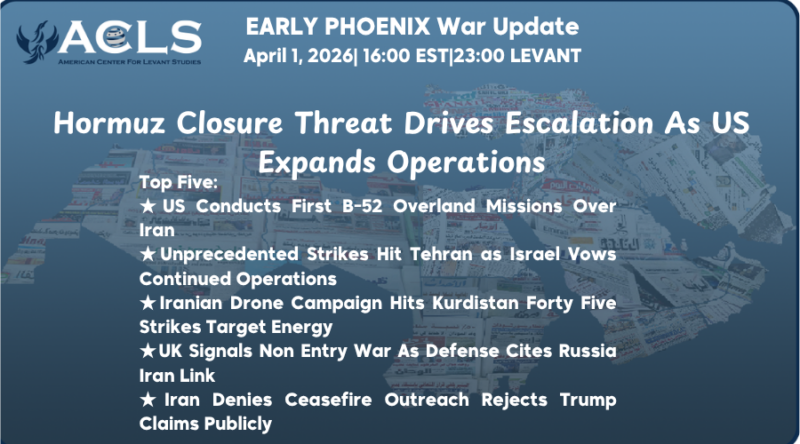
US Conducts First B-52 Overland Missions Over Iran
U.S. officials said B-52 Stratofortress bombers have begun overland missions inside Iran, marking a shift following degraded air defenses. Dan Caine stated at a Pentagon briefing the flights reflect increased air superiority, with Pete Hegseth citing continued but reduced Iranian missile threats. The New York Times and multiple outlets reported the missions as the first such operations during the conflict.
-
Unprecedented Strikes Hit Tehran as Israel Vows Continued Operations
Massive explosions rocked Tehran, Ahvaz, Kermanshah, Shiraz, and Karaj amid Israel’s ongoing campaign, which has conducted over 800 sorties dropping 16,000 munitions on 4,000 targets, killing more than 2,000 Iranian soldiers and commanders. Iran launched missiles toward southern Israel and the Negev, with minor injuries reported. Israel and the U.S. signal the war may soon conclude, while mediation efforts continue.
-
UK Signals Non Entry War As Officials Cite Russia Iran Link
UK Prime Minister Keir Starmer said Britain will not enter the war and seeks de escalation, while Defense Secretary John Healey confirmed prior authorization for U.S. use of UK bases and cited possible Russian support to Iranian tactics. Iranian Ambassador Ali Mousavi said Tehran is assessing UK bases as potential targets, highlighting tension between declared non involvement and ongoing operational support.
-
Iran Denies Ceasefire Outreach Rejects Trump Claims Publicly
Iranian President Masoud Pezeshkian told European Council President António Costa Iran has the will to end the war if firm guarantees prevent renewed US Israeli attacks. President Trump said the US would consider a ceasefire only after the Strait of Hormuz is open and secure, while warning continued strikes against Iran. Hours later, Iran’s foreign ministry issued a statement claiming that President Trump’s claim is false and maintained it has not approached the United States for ceasefire negotiations.
-
Pezeshkian Addresses Americans Rejects Hostility Questions War Continuation
Iranian President Masoud Pezeshkian addressed the American public, stating Iran holds no hostility toward U.S. citizens and has not initiated wars, while framing ongoing military actions as self defense. He said continued conflict imposes growing costs on populations and questioned its value for Americans, accusing Washington of unjustified strikes during negotiations, as the White House announced Donald Trump will deliver a national address on the war.
-
Global Media Intensifies Speculation Ahead Of Trump Iran Address
U.S. and international outlets including Reuters and Axios report expanding global speculation over President Donald Trump’s address on Iran, with analysts projecting he will claim major objectives achieved while avoiding commitment to a ground invasion. Officials signal continued strategic ambiguity and conditional openness to talks, with no confirmed timelines, ceasefire terms, or new operational phase announced.
-
Rosatom Expands Bushehr Evacuations As Conflict Threatens Nuclear Site
Rosatom is continuing phased evacuations from Iran’s Bushehr Nuclear Power Plant, with Reuters reporting 163 staff already withdrawn and additional groups planned as conditions deteriorate. Wall Street Journal previously reported plans to evacuate up to 200 personnel.
-
Airstrikes Put Qeshm Island Desalination Plant Out of Service
Iranian media reported that airstrikes have disabled a desalination plant on Qeshm Island in the Strait of Hormuz, with repairs not possible in the short term. Iran blamed the U.S. for the March 7 attack, part of broader US-Israeli strikes on Iranian military and infrastructure sites since February 28, raising concerns over critical water supply disruptions in the Gulf.
-
Argentina Labels Iran’s IRGC a Terrorist Organization, Aligning with US
Argentina designated Iran’s Islamic Revolutionary Guard Corps (IRGC) as a terrorist group, citing its support for Hezbollah, responsible for the 1994 AMIA bombing in Buenos Aires that killed 85. The move enables financial sanctions and operational restrictions, aligning Argentina with US policy, which already lists the IRGC and Hezbollah as terrorist organizations.
=========
★UNITED STATES
-
Rubio Sees “End Line” in Iran War, U.S. to Reassess NATO Ties
U.S. Secretary of State Marco Rubio said Washington can now “see the end line” in the Iran war, which began February 28 with U.S.-Israeli strikes. He indicated possible direct talks with Tehran and warned the U.S. may reconsider NATO relations, citing European restrictions on American base use and lack of allied support during operations.
-
Iraqi Authorities Link Journalist Kidnapping To Kataib Hezbollah Operative
Gunmen abducted American journalist Shelly Kittleson in central Baghdad during daylight, as video shows assailants forcing her into a vehicle at a crowded intersection. Iraqi officials said a detained suspect belongs to Brigade 45 of the Popular Mobilization Forces linked to Kataib Hezbollah, with her belongings recovered from his vehicle near Musayyib, as security forces continue operations to locate and free her.
-
China and Pakistan Propose Five-Point Plan to End Middle East War
China and Pakistan called for an immediate ceasefire and peace talks in the Middle East, outlining a five-point plan during a visit by Pakistani officials to Beijing. The initiative urges dialogue, the protection of civilians and infrastructure, the secure passage of shipping through the Strait of Hormuz, and a lasting peace based on the UN Charter and international law.
============
★ISRAEL
-
IDF Targets Iranian Chemical Facility Linked to Weapons Program
The IDF struck a factory owned by Tofiq Daru Company, accused of supplying fentanyl to Iran’s SPND for chemical weapons development, saying it impaired production capabilities. The site allegedly operated as a civilian front. The strike is part of broader attacks on key Iranian military and nuclear-related targets, with precautions to limit civilian harm.
-
Israel Intercepts Missile Fired from Yemen
The Israeli military reported detecting a missile launched from Yemen toward Israel, with air defenses successfully intercepting it. Sirens sounded in Beersheba, Ashkelon, Sderot, and Dimona. The Iran-aligned Houthi group has recently joined regional hostilities, though it has not claimed responsibility for Wednesday’s launch.
-
Hamas Calls Hezbollah to Kidnap Israeli Soldiers After Law
A Hamas spokesperson, Abu Ubaida of the Izz ad-Din al-Qassam Brigades, urged Hezbollah to intensify efforts to kidnap Israeli soldiers in Lebanon to secure prisoner releases after Israel’s Knesset passed a death penalty bill for terrorists. He condemned the move and alleged actions at Al-Aqsa, calling for broader resistance and pressure against Israel.
-
Israel Approves $31.6 Million Emergency Aid During Iran Conflict
The Israeli government allocated 100 million shekels ($31.6 million) in emergency funding to regional councils to cover war-related expenses from the ongoing conflict with Iran. The package supports essential municipal services, prioritizes heavily affected communities, and may expand with additional compensation if the conflict continues, amid growing local concerns over security and financial pressures.
==========
★LEBANON
-
Hezbollah Rockets and Drones Strike Northern Israel, Injuring Civilians
Over 50 rockets and drones launched by Hezbollah struck northern Israel’s Upper Galilee, injuring three people, including a child, while earlier attacks involving Iranian munitions wounded eight in central Israel. Shrapnel caused damage, fires, and panic, with emergency services treating multiple casualties across affected areas.
-
Israel Strikes Mansourieh and Beirut Suburbs in Lebanon
For the first time, Israel targeted an apartment in Mansourieh, north of Beirut, a predominantly Christian area, while earlier airstrikes hit buildings near Beirut’s airport and southern suburbs following evacuation warnings. Israeli forces continue operations across southern Lebanon, establishing a security zone up to the Litani River to counter Hezbollah and anti-tank threats.
=========
★GULF STATES
-
Iranian Drone Campaign Hits Kurdistan Forty Five Strikes Target Energy
Iranian and Iraqi militias conducted 45 drone and missile attacks across Erbil, Dohuk, and Sulaymaniyah within 24 hours, with 35 strikes concentrated in Erbil targeting oil infrastructure, residential areas, and security sites. Two Iranian Shahed drones struck a British-linked Castrol facility in Erbil, igniting a major fire, while separate strikes damaged US-linked HKN oil assets in Dohuk, as repeated swarm attacks and overnight waves caused infrastructure damage but no reported casualties.
-
Saudi Arabia, Qatar, Jordan Agree on Arab Plan to Counter Iran
Leaders of Saudi Arabia, Qatar, and Jordan met in Jeddah to coordinate a unified response to rising regional tensions amid the Israel-Iran conflict, with US participation. The summit emphasized that Gulf and Jordanian security are interconnected, focusing on joint strategies to manage the military escalation and strengthen regional stability.
-
Emirates Bars Iranian Nationals from Entering or Transiting the UAE
Dubai-based airline Emirates announced that Iranian nationals are prohibited from entering or transiting the UAE, while Flydubai allows entry for holders of UAE “Golden Visas.” The restrictions come amid rising tensions between Iran and Gulf states, reflecting regional security concerns and travel policy adjustments.
-
Iranian Attacks Target Gulf Airports, Oil Facilities, Ships
Iran launched coordinated attacks on Gulf states, hitting Kuwait International Airport with drones that caused a large fuel tank fire without casualties. Bahrain reported a similar attack on an industrial facility. At the same time, a tanker off Doha sustained minor damage from a projectile, with no injuries, according to local authorities and the UK Maritime Trade Operations.
-
Gulf Defenses Intercept Iranian Missiles and Drones
The UAE intercepted 12 Iranian projectiles, including eight ballistic missiles, four cruise missiles, and 36 drones, while Kuwait destroyed five ballistic missiles and seven drones. Since the attacks began, Gulf defenses have countered hundreds of missiles and thousands of drones, maintaining readiness to protect regional security under international law.
===========
★ Disclaimer: This publication is a digest of various news sources compiled by the Early Phoenix team and edited by Rania Kisar. The items are curated, concise summaries of news items hyperlinked within each story. The items and summaries presented do not necessarily represent the views of the American Center for Levant Studies.