★UNITED STATES
-
Trump Signals Escalation Timeline Warns Further Strikes Without Agreement
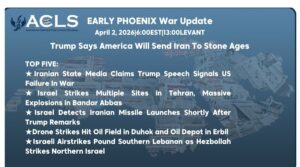
President Donald Trump said the United States will bring Iran “back to the stone ages” and stated U.S. forces will strike “very hard” within two to three weeks if no agreement is reached. He said “we have all the cards, they have none.” He identified electric power infrastructure as potential targets and confirmed U.S. forces have not targeted oil facilities. President Donald Trump compared the current operation to World War I, World War II, Korea, Vietnam, and Iraq, noting those conflicts lasted years while the Iran campaign unfolded in roughly one month. He said Iran has been “eviscerated” in 32 days and assessed the operation is nearing completion.
-
Markets Slide Oil Prices Surge After Trump Signals Escalation
Global markets fell and oil prices surged after President Donald Trump warned of further strikes against Iran and offered no timeline for de-escalation. U.S. futures dropped about one percent while European and Asian markets declined. Crude prices jumped, with Brent and WTI rising sharply. The U.S. dollar strengthened as investors reacted to increased conflict risk and potential disruption to energy flows.
-
36 Countries Urge Diplomatic Efforts to Reopen Hormuz
Around 36 nations are meeting virtually, led by UK Foreign Secretary Yvette Cooper, to push for reopening the Strait of Hormuz, disrupted by US-Israeli actions against Iran. PM Keir Starmer said the aim is safe navigation and resuming vital trade, while Iran’s attacks halt shipping and the US refuses involvement, leaving military options under review.
==========
★IRAN
-
Iranian State Media Claims Trump Speech Signals US Failure In War
Tasnim News Agency said President Donald Trump’s address reflected a shift in U.S. war objectives. It said the shift was intended to enable a future claim of victory. The outlet asserted Washington failed to achieve key goals. These included control of the Strait of Hormuz and elimination of Iran’s capabilities. It argued Trump’s remarks signaled inability to reopen the strait. It also said the speech relied on propaganda framing. The outlet claimed the address acknowledged failure in the month-long conflict.
-
Senior Iranian Official Kamel Kharazi Injured, Wife Killed in Tehran Strike
A missile or airstrike, reportedly by US and Israeli forces, targeted the home of senior Iranian official Kamel Kharazi in Tehran, seriously wounding him and killing his wife. Kharazi, a close advisor to Iran’s Supreme Leader and head of the Strategic Council for Foreign Relations, was hospitalized, while the attack caused extensive damage to his residence amid rising regional tensions.
==========
★ISRAEL
-
Israel Detects Iranian Missile Launches Shortly After Trump Remarks
The Israeli military said it detected missiles launched from Iran shortly after President Donald Trump finished his remarks. Air defense systems were activated to intercept the incoming threats. Sirens sounded across northern Israel as interceptors engaged the missiles. Israeli officials did not confirm casualties or damage immediately after the launches.
-
Israel Strikes Multiple Sites in Tehran, Massive Explosions in Bandar Abbas
Israeli airstrikes targeted dozens of military sites across Tehran, including 15 weapons production facilities, missile and drone development sites, and air defense infrastructure. Simultaneous explosions were reported in Bandar Abbas, Ahvaz, Shiraz, and Qeshm, causing extensive damage. The IDF said over 400 Iranian targets were hit in the past two days, marking one of the largest escalations in the ongoing conflict.
-
Iran, Hezbollah Launch Missile Attacks as Israelis Shelter During Passover
Iran fired a major ballistic missile barrage, including cluster warheads, at central and northern Israel, while Hezbollah launched rockets from Lebanon, sending millions into bomb shelters on Passover. Several civilians were lightly injured, and infrastructure was damaged in Bnei Brak, Rosh Haayin, and Petah Tikva. The IDF responded with over 400 airstrikes on Iranian military and missile sites.
==========
★LEBANON
-
Israeli Airstrikes Pound Southern Lebanon as Hezbollah Strikes Northern Israel
Israeli jets targeted Harouf, Burj Rahal, and Zibdeen, destroying buildings and causing multiple injuries, while artillery hit Shuqra, Wadi Salouqi, Mansouri, Majdal Zoun, Wadi Hamra, and Qalaat Dubieh. Hezbollah retaliated with drones and rockets toward northern Israel, triggering sirens, though no casualties were immediately reported. Lebanon’s health ministry confirmed four dead and three injured, raising the war toll since March 2 to 1,318 killed and 3,935 wounded, including 125 children and 53 healthcare workers.
-
IDF Strikes Hezbollah Finance Sites, Kills Senior Commander Hashem
The Israel Defense Forces struck two Beirut exchange offices used by Hezbollah to channel Iranian funds for attacks on Israel. In a separate naval strike, senior Southern Front commander Hajj Yusuf Ismail Hashem was killed after leading rocket and aerial attacks and overseeing key Hezbollah combat units.
==========
★IRAQ
-
Drone Strikes Hit Oil Field in Duhok and Oil Depot in Erbil
As the Iran-Israel-US conflict spreads to Iraq, a drone targeted the Sarsank oil field in Duhok, while another struck a Castrol oil depot in Erbil, sparking a large fire. Previous drone attacks hit the US consulate and military bases in Erbil.
=========
★GULF STATES
-
Mohamed bin Zayed and Trump Discuss Regional Tensions
UAE President Mohamed bin Zayed spoke with US President Donald Trump by phone on regional developments and their impact on global security, trade, and navigation. They discussed Iranian attacks on the UAE, including 438 ballistic missiles, 19 cruise missiles, and 2,012 drones, which killed 12 and injured 190, stressing the need to uphold sovereignty and stability.
-
Gulf States Explore Alternatives to Strait of Hormuz
Gulf countries are planning multiple routes to reduce dependence on the Strait of Hormuz, including expanded Red Sea capacity, overland corridors to the Mediterranean, and pipelines or railways. Saudi Arabia’s East-West pipeline to Yanbu serves as a model, allowing steady exports while bypassing Hormuz, as Gulf states seek to secure energy flows amid regional tensions.
==========
★ Disclaimer: This publication is a digest of various news sources compiled by the Early Phoenix team and edited by Rania Kisar. The items are curated, concise summaries of news items hyperlinked within each story. The items and summaries presented do not necessarily represent the views of the American Center for Levant Studies.