★UNITED STATES
-
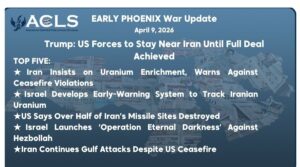
Trump: US Forces to Stay Near Iran Until Full Deal Achieved
President Trump announced that US military forces will remain deployed around Iran to enforce the ceasefire and ensure compliance. He warned that any violation by Tehran would trigger a stronger response, emphasizing deterrence and rapid reaction. The deployment also aims to prevent Iran from acquiring nuclear weapons and to keep the Strait of Hormuz open, with Israel echoing readiness to act if the truce fails.
-
US Sends Team for Iran Talks
The US is sending a delegation led by JD Vance to Pakistan for Iran talks following a ceasefire, with Steve Witkoff and Jared Kushner participating. The White House said Iran signaled willingness to hand over enriched uranium, a key US demand. Washington also seeks unrestricted reopening of the Strait of Hormuz amid rising traffic.
-
US Says Over Half of Iran’s Missile Sites Destroyed
A US official told the Wall Street Journal that more than 50% of Iran’s missile launch platforms were destroyed, with over 13,000 targets hit, including 4,000 strategic sites. Defense Secretary Beth Higsith called it a decisive victory, while Gen. Dan Keen reported 90% of Iran’s naval and weapons infrastructure was eliminated. Forces remain on high alert despite the temporary ceasefire.
===========
★IRAN
-
Iran Insists on Uranium Enrichment, Warns Against Ceasefire Violations
Iran reaffirmed its right to enrich uranium ahead of US-Iran talks in Islamabad, with Atomic Energy chief Mohammad Eslami rejecting US restrictions. Vice President Mohammad Reza Aref warned that any breach of the ceasefire would face a “decisive and painful” response. Parliament Speaker Mohammad Bagher Ghalibaf will lead the Iranian delegation, while the US team is headed by VP JD Vance, with talks set to start Saturday.
-
Iran Considers Crypto Fees for Strait of Hormuz Transit
Iran is reportedly exploring transit fees for vessels passing through the Strait of Hormuz, potentially payable in cryptocurrency, to monitor maritime traffic and prevent weapon transfers during the two-week ceasefire. The plan, aimed at tightening control over the strategic energy corridor, could bypass international sanctions while slowing shipping through one of the world’s busiest chokepoints.
-
Costa Rica labels IRGC, Hezbollah, Hamas, Houthis as Terrorists
Costa Rica designated Iran’s IRGC, Hezbollah, Hamas, and Yemen’s Houthis as terrorist organizations to strengthen counterterrorism efforts and curb financing networks. The move aims to enhance intelligence and judicial actions while protecting national security. It follows similar designations by several countries and aligns with international commitments against terrorism.
===========
★ISRAEL
-
Israel Develops Early-Warning System to Track Iranian Uranium
The Israeli military is building a specialized “alert model” to detect attempts to extract underground enriched uranium in Iran, particularly in Isfahan and Natanz. Intelligence units will share data with the US as both nations monitor Iranian activity. The move comes ahead of US-Iran talks in Islamabad aimed at ending the conflict that began on February 28.
===========
★LEBANON
-
Israel Launches ‘Operation Eternal Darkness’ Against Hezbollah
Israel announced a new offensive, “Operation Eternal Darkness,” targeting Hezbollah infrastructure across Lebanon. Defense Minister Israel Katz said the group suffered its heaviest blow since the 2024 Beeger Operation, striking hundreds of militants in Beirut and southern Lebanon. The IDF warned Hezbollah of high costs for attacks on Israel and vowed continued operations to neutralize threats and weaken the group’s capabilities.
-
Israel kills Hezbollah’s Deputy Leader, Nephew in Beirut Strike
The Israeli army announced it had assassinated Hezbollah’s deputy leader, Naim Qassem, and his nephew Ali Harshi in a Beirut raid, targeting multiple Hezbollah command centers, weapon depots, and launch sites in southern Lebanon. The strikes killed over 250 people and wounded 1,200, overwhelming hospitals. Hezbollah vowed continued attacks on northern Israel amid escalating conflict.
-
Hezbollah Fires Rockets at Northern Israel After Ceasefire Breach
Hezbollah launched rockets at northern Israel early Thursday, citing Israeli violations of the US-Iran two-week ceasefire. The group targeted the settlement of Manara and vowed continued attacks “until Israeli-American aggression” against Lebanon stops, marking its first strike since the ceasefire agreement.
-
Israeli Soldier Killed, Five Wounded in Southern Lebanon Clash
An Israeli Golani brigade raid in Taybeh, southern Lebanon, left Sergeant Tobal Libshits dead and five soldiers injured, one critically, after Hezbollah fighters opened fire at close range. Israel retaliated with airstrikes to isolate the area, reportedly killing several militants. Since the start of Operation “Roaring Lion” in Iran, 12 Israeli soldiers have died in Lebanon.
===========
★GULF STATES
-
Qatar and France Discuss Regional De-Escalation Efforts
Qatar’s Emir Tamim bin Hamad and French President Emmanuel Macron discussed efforts to sustain de-escalation following the US-Iran ceasefire, stressing a lasting agreement to secure energy stability and maritime routes. They reviewed global impacts of air and sea closures, Lebanon tensions, and upcoming US-Iran talks in Pakistan.
-
Iran Continues Gulf Attacks Despite US Ceasefire
Despite a US-Iran two-week ceasefire, Iran launched multiple assaults on Gulf states within 24 hours, targeting Saudi Arabia, UAE, Kuwait, Qatar, and Bahrain. Gulf defenses intercepted dozens of missiles and drones, causing damage to oil, power, and water infrastructure. GCC officials warn the attacks test regional security, even as the ceasefire aims to end the six-week conflict.
===========
★ Disclaimer: This publication is a digest of various news sources compiled by the Early Phoenix team and edited by Rania Kisar. The items are curated, concise summaries of news items hyperlinked within each story. The items and summaries presented do not necessarily represent the views of the American Center for Levant Studies.