

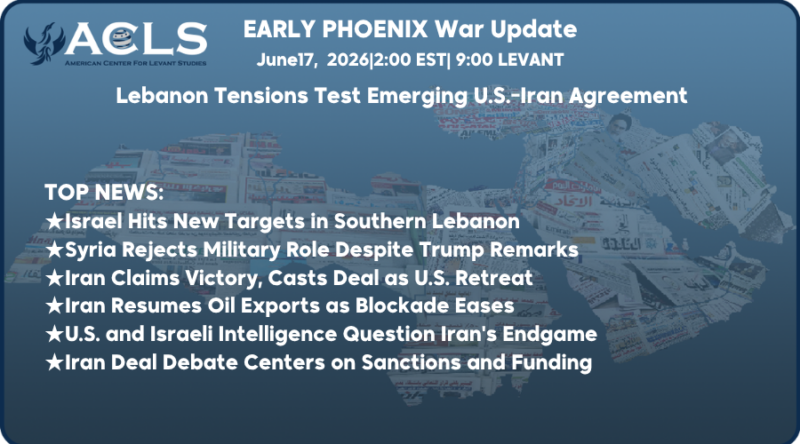
Lebanon Tensions Test Emerging U.S.-Iran Agreement
As Washington and Tehran prepare to sign a memorandum launching nuclear negotiations, Lebanon has emerged as a potential challenge to broader de-escalation efforts. Iran warned it could respond forcefully if Israeli operations in southern Lebanon continue, while Hezbollah said Tehran is unlikely to finalize a nuclear agreement with Washington unless Israeli forces withdraw from Lebanese territory. Israeli Alma Research Center reported that Hezbollah launched 134 attack waves against Israel and Israeli forces during June 8–14, down from 198 the previous week, suggesting Israeli operations may be reducing the group’s operational tempo.
Israel Hits New Targets in Southern Lebanon
Israeli strikes killed four people in southern Lebanon on Tuesday, while Israel said it intercepted rockets fired toward its forces and destroyed the launcher. On Wednesday morning, Israeli warplanes and drones struck Nabatieh al-Fawqa and nearby areas in southern Lebanon, continuing a series of operations across the Nabatieh district.
Syria Rejects Military Role Despite Trump Remarks
Syrian President Ahmad al-Sharaa reiterated that Damascus has no intention of intervening militarily in Lebanon, emphasizing support for Lebanese institutions and economic cooperation. The statement preceded President Trump’s suggestion that Syria could be more effective than Israel in dealing with Hezbollah. Analysts view the remarks primarily as a signal of Washington’s desire to reduce fighting on the Lebanese front rather than evidence of an emerging Syrian intervention plan.
Iran Claims Victory, Casts Deal as U.S. Retreat
Iranian officials are portraying the U.S.-Iran memorandum as a strategic victory, arguing that Washington and Israel failed to achieve their war aims and were forced into negotiations. State media claim Iran’s deterrence remains intact. Tehran is also presenting the agreement as evidence of growing regional support for its position.
Iran Resumes Oil Exports as Blockade Eases
Iran has reportedly resumed significant crude oil exports for the first time in nearly two months, with two supertankers carrying an estimated 3.8 million barrels departing a U.S. Navy blockade zone in the Gulf, according to TankerTrackers. A third tanker is also approaching the area, potentially signaling a broader recovery in Iranian oil shipments as implementation of the U.S.-Iran memorandum begins. However, maritime security sources warn that mine-clearing operations and insurance concerns could delay a full return to normal shipping activity for 40-50 days.
U.S. and Israeli Intelligence Question Iran’s Endgame
Growing skepticism is emerging within both Washington and Jerusalem over Iran’s intentions during the 60-day negotiation period established by the U.S.-Iran memorandum. Ratcliffe, Rubio, and Hegseth reportedly believe Iran may be unwilling to make the nuclear concessions sought by the United States. Israeli intelligence reportedly believes Tehran intends to use the negotiation period to secure sanctions relief and buy time rather than finalize a nuclear agreement. Reinforcing those concerns, a U.S. official told NBC News that Iran’s Revolutionary Guard has launched drones toward commercial shipping in the Strait of Hormuz each night since the memorandum was signed, with U.S. forces intercepting them before they reached their targets.
Iran Deal Debate Centers on Sanctions and Funding
Vice President JD Vance said the pending U.S.-Iran memorandum would impose nuclear restrictions, secure freedom of navigation through the Strait of Hormuz, and condition any economic benefits on Iranian compliance. He rejected claims of a guaranteed $300 billion transfer, describing it as a potential foreign-backed investment mechanism contingent on a final agreement. However, draft provisions reviewed by multiple outlets suggest Iran could gain immediate oil-sale revenues and potentially broader sanctions relief during negotiations. The extent and timing of any economic benefits remain disputed pending publication of the agreement’s final text.
==========
★ Disclaimer: This publication is a digest of various news sources compiled by the Early Phoenix team and edited by Rania Kisar. The items are curated, concise summaries of news items hyperlinked within each story. The items and summaries presented do not necessarily represent the views of the American Center for Levant Studies.