

IRAN & LEBANON
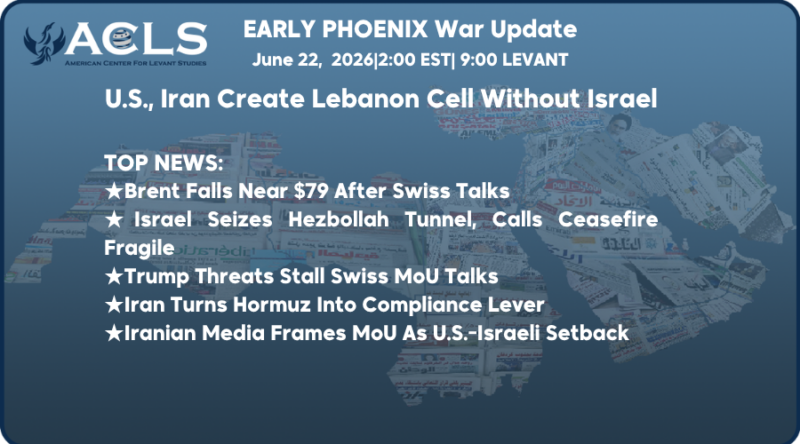
U.S., Iran Create Lebanon Cell Without Israel
Qatar and Pakistan said the first Swiss round of U.S.-Iran talks ended with a 60-day roadmap, continued technical talks, a Hormuz communication line, and a Lebanon deconfliction cell involving the parties, Lebanon and the mediators. The statement did not mention Israel, although the mechanism is meant to monitor the halt of military activity in Lebanon. Iran’s Abbas Araghchi called the cell the “first real test,” while his claims on oil waivers, assets and reconstruction remain unconfirmed by Washington. Kan separately reported Israel is preparing to reduce some forces as Israeli-Lebanese teams map pilot zones for Lebanese Army control. Other Israeli reports say Washington is not demanding a full IDF withdrawal for now, but wants tighter coordination and more limited Israeli operations.
Brent Falls Near $79 After Swiss Talks
Brent crude fell toward $79 a barrel Monday after the first U.S.-Iran talks in Switzerland produced signs of progress toward a 60-day roadmap. Reuters reported Brent down about 1.9% near $79.04, while live quote screens showed it fluctuating around $79. Markets appeared to price in lower immediate supply risk after mediators announced technical talks, a Hormuz communication line, and Iran claimed oil and petrochemical export waivers.
Israel Seizes Hezbollah Tunnel, Calls Ceasefire Fragile
The IDF said its 551st Brigade seized a Hezbollah tunnel in Majdal Zoun, about 10 kilometers inside Lebanon, with four rocket-launch shafts, 12 rooms and weapons including anti-tank missiles and drones. Israel said more than 20 Hezbollah fighters, including over 10 Radwan members, were killed and 50 sites destroyed. IDF Chief Eyal Zamir separately told troops the Lebanon ceasefire is fragile and Israel must be ready to resume attacks.
Trump Threats Stall Swiss MoU Talks
Iran and the United States opened Switzerland talks in a mediated four-party format with Pakistan and Qatar, after President Masoud Pezeshkian said Tehran would not abandon uranium enrichment. At the beginning of the meetings, Iran rejected normalization optics with the U.S. delegation,then protested Trump’s threats over Lebanon and Hormuz. Iranian outlets said the delegation refused to resume the formal session after a break, while U.S. and mediator accounts said engagement continued and produced progress.
Lebanon Becomes MoU’s First Compliance Test
Iranian officials made Lebanon the first test of U.S. compliance with the MoU, arguing that continued Israeli operations in southern Lebanon violate the agreement’s halt to hostilities on all fronts. Israel says its forces retain freedom to act against threats, while Hezbollah says it will respond to Israeli violations. Tehran is using the Lebanon file to challenge whether Washington can enforce the agreement on Israel before nuclear talks move forward.
Iran Turns Hormuz Into Compliance Lever
Iran again declared the Strait of Hormuz closed after accusing the United States and Israel of violating the MoU through continued Israeli operations in Lebanon. Shipping traffic through the strait slowed sharply, though U.S. officials said commercial movement continued. Trump threatened to take control of the waterway, while Iranian officials dismissed the warning and linked any reopening to full implementation of the agreement.
Iranian Media Frames MoU As U.S.-Israeli Setback
Iranian state and aligned outlets are presenting the MoU as evidence that U.S. military pressure failed, Israel was politically isolated, and Tehran entered negotiations from a stronger position. The messaging emphasizes depleted U.S. arsenals, Hormuz leverage, Israeli vulnerability in Lebanon, and Iran’s refusal to accept humiliation. The claims are unevenly verified, but they show how Tehran is shaping public expectations before the next phase of talks.
============
★ Disclaimer: This publication is a digest of various news sources compiled by the Early Phoenix team and edited by Rania Kisar. The items are curated, concise summaries of news items hyperlinked within each story. The items and summaries presented do not necessarily represent the views of the American Center for Levant Studies.