

★GULF STATES
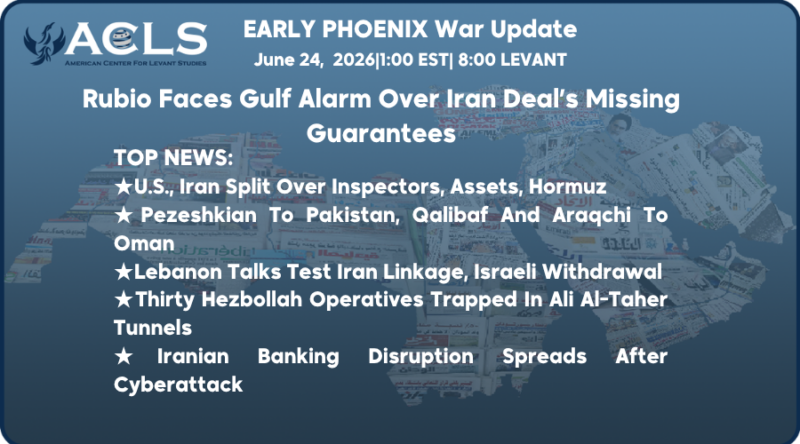
Rubio Faces Gulf Pushback Over Iran Deal
Rubio arrived in the UAE on a Gulf reassurance tour after the U.S.-Iran MoU alarmed allies hit by Iranian missiles and drones during the war. Reuters and AP said Gulf leaders worry the deal delays the nuclear question, omits explicit missile limits, leaves proxies insufficiently constrained, opens the door to a $300 billion Iran fund, and could give Tehran leverage over Hormuz. Rubio said the fund depends on Iran choosing to be “a country instead of a revolutionary movement that exports terror,” and rejected any Hormuz tolls or fees. Israel Hayom, citing diplomatic sources, said the UAE is refusing to release $3 billion in Iranian funds and wants compensation and maritime guarantees, while Rubio also faces tension with Vance’s Iran-linked Lebanon monitoring track.
Arab Experts See U.S. Iran MoU Fragile, Rushed, And Highly Contested
Arab analysts said the U.S.–Iran memorandum looks less like a breakthrough than a fragile truce sold by JD Vance as an American win on Hormuz, energy, and markets. They warned Washington is rushing relief to Tehran before verified compliance, while Gulf states remain unconvinced on missiles, drones, militias, Hezbollah funding, and guarantees against future attacks. Several experts said the deal risks repeating 2015 by financing Iran’s regional agenda while leaving allies exposed. Mehr separately quoted Iran’s Foreign Ministry spokesman saying Tehran will not negotiate missiles, rejects IAEA inspections of damaged sites, and sees formal nuclear talks as conditional on sanctions relief, oil sales, unfrozen assets, Hormuz sovereignty, and Lebanon de-escalation.
============
★IRAN
U.S., Iran Split Over Inspectors, Assets, Hormuz
President Trump said Iran agreed to long-term nuclear inspections and warned there would be no further talks if Tehran refuses, while also saying IAEA inspectors will enter damaged nuclear sites at the appropriate time. Tehran denied any new nuclear commitment and said there is no plan for IAEA inspections of sites bombed by Israel and the United States. After Iran’s denial, Trump said Tehran was “wrong,” adding, “They told us inside and we have it down, 100% inspections. And if they were right, I’d cancel the meetings right now.”
U.S. Allows Dollar Payments For Iranian Oil Sales Under Waiver
Washington authorized temporary oil-related waivers as traffic resumed through Hormuz, with Trump saying any released funds would remain in U.S.-controlled escrow for humanitarian purchases. The OFAC license permits covered Iranian crude, petroleum, and petrochemical transactions, including payments owed to Iran or blocked Iranian entities in U.S.-dollar-denominated funds, marking a major but temporary sanctions easing under the U.S.-Iran MoU. Iran’s Central Bank chief separately claimed the Switzerland talks produced progress on blocked assets, oil exports, and OFAC waivers, but said the first $6 billion is governed by a 2023 essential-goods mechanism and is not limited to U.S. agricultural imports.
Pezeshkian To Pakistan, Qalibaf And Araqchi To Oman
Iran split its post-MoU diplomacy Tuesday, with President Masoud Pezeshkian visiting Pakistan as Islamabad sought to consolidate its mediator role and support implementation of the U.S.-Iran framework. In Islamabad, Pezeshkian said Iran will not negotiate over its defense and deterrence capabilities, arguing its missiles prevented Israel and the United States from treating Iran like Gaza. He met Prime Minister Shehbaz Sharif, President Asif Ali Zardari, and Field Marshal Asim Munir. In Oman, Mohammad Baqer Qalibaf and Abbas Araqchi backed a joint working group on Hormuz navigation and maritime services as crude and Qatar-linked LNG traffic resumed through the strait.
Iranian Banking Disruption Spreads After Cyberattack
Iran International said services at eight Iranian banks were severely disrupted Tuesday, while Reuters reported Iran’s state-owned banking technology provider confirmed cyberattacks had hit card-based services at Melli, Saderat, and Tejarat. The provider said card operations were temporarily suspended to protect customer data and assets. The outage follows a June 13 attack on shared banking infrastructure, adding pressure on Iran’s financial system during the post-war diplomatic window.
Tasnim Tracks Israeli Electrical Failures After Fires
Tasnim Reports Israeli Electrical Fires In Hadera, Karmiel
Tasnim reported that a June 17 fire in Hadera was caused by electrical disruptions, citing Israeli fire services and saying the preliminary cause was a central air-conditioning malfunction. On June 22, Tasnim reported a second incident in Karmiel, saying Hebrew-language media described an explosion and fire at a regional power substation that caused several hours of electricity disruption across large parts of the city.
Israel’s Bennett Claims Starlink Smuggling, Iran Arrests Thousands
Former Israeli Prime Minister Naftali Bennett said Israel smuggled tens of thousands of Starlink receivers into Iran to help protesters bypass regime internet shutdowns, but accused Netanyahu’s government of failing to complete the effort. IranWire separately reported that Iran’s judiciary announced 3,292 arrests for “collaboration with the enemy,” including 684 people accused of operational activity for Israel and 1,258 accused of political, propaganda, or media activity. Amnesty said Tehran is using wartime conditions to intensify mass arrests, unfair proceedings, executions, prison sentences, and asset confiscations.
=========
★LEBANON
Lebanon, Israel Weigh Pilot Withdrawal Zone
Lebanon and Israel opened a fifth U.S.-hosted negotiating round in Washington, with Beirut pressing for a timetable for Israeli withdrawal and Israel demanding Hezbollah’s disarmament before broader movement. The most concrete proposal under discussion is a U.S.-monitored pilot zone, possibly near Beaufort Castle, where Israel would partially withdraw and the Lebanese Army would deploy. Same-day Israeli fire near Nabatieh underscored the fragility of the track.
Israel Envoy Calls Lebanon-Iran Linkage Train Wreck
Times of Israel said Israel and Lebanon opened a fifth round of direct talks in Washington, with partial IDF withdrawal from southern Lebanon under discussion. Israeli Ambassador Yechiel Leiter called the U.S. decision to include Lebanon in the Iran MoU a “train wreck,” saying talks were meant to remove Iran from Lebanon, not let Tehran restrain Hezbollah.
Thirty Hezbollah Operatives Trapped In Ali Al-Taher Tunnels
Israeli outlets reported that around 30 Hezbollah operatives remain trapped inside a fortified underground facility near Kfar Tebnit on Ali al-Taher Ridge, while Hezbollah denies any fighters are besieged. The same reports warned of possible Radwan attempts to capture Israeli soldiers, but no such operation is confirmed.
Israeli Generals Split Over Lebanon Restraint Price
Former Israeli National Security Adviser Yaakov Amidror told Arutz Sheva that Iran has tied Lebanon to U.S. nuclear talks, causing Washington to press Israel to limit responses against Hezbollah. He said Israel should preserve soldiers’ self-defense and operational freedom while giving Washington a chance to remove Iran’s enriched uranium. Former IDF commander Itzhak Brik warned the U.S.–Iran process could let Iran shape an IDF withdrawal from Lebanon, urging Israel to hold a defensive line protecting northern communities while coordinating with Washington.
Israel Fears Syria Role Could Reshape Lebanon
Israel’s Channel 12 said Netanyahu will convene a Syria-Lebanon discussion after Trump suggested Syria could help handle Hezbollah. The report said Israeli officials fear the idea may reflect behind-the-scenes planning, not loose language, and could allow Ahmed al-Sharaa’s regime to regain influence in Lebanon after Syria’s 2005 withdrawal. Al-Sharaa rejected sending forces into Lebanon, but said Syria could play a positive role through Lebanese institutions.
============
★ Disclaimer: This publication is a digest of various news sources compiled by the Early Phoenix team and edited by Rania Kisar. The items are curated, concise summaries of news items hyperlinked within each story. The items and summaries presented do not necessarily represent the views of the American Center for Levant Studies.