

★ GULF STATES
Gulf States Press Rubio For Iran Guarantees
Secretary of State Marco Rubio told Gulf ministers that any final U.S.-Iran agreement would not come at the expense of Gulf security. A Kuwaiti analyst said any final agreement must include enforceable commitments on Iran’s missiles, proxies, Hormuz transit, and non-interference. A joint U.S.-GCC statement also called for addressing Iran’s missiles, drones, and regional proxies.
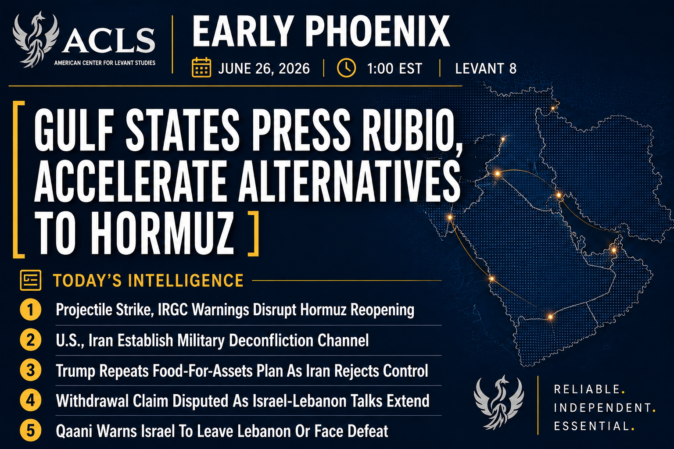
Projectile Strike, IRGC Warnings Disrupt Hormuz Reopening
A cargo vessel was struck by an unknown projectile near Oman, damaging its bridge but causing no casualties or pollution. The incident followed Iranian warnings that ships must use Tehran-approved routes through Hormuz. Iranian and shipping outlets said three tankers reversed course after IRGC warnings. Reuters said the IMO paused a ship-evacuation initiative to reassess safety guarantees. The incidents raise doubts over safe passage, insurance, and the pace of reopening the strait.
Gulf States Accelerate Trade Routes Beyond Hormuz
Gulf logistics operators are expanding alternative trade routes as Hormuz risks persist. AD Ports launched weekly services linking Abu Dhabi’s Khalifa Port to Iraq’s Umm Qasr, creating a Gulf-Iraq-Turkey-Europe corridor, while Saudi Arabia and Turkey signed logistics and railway cooperation agreements and discussed Gulf-Europe freight links through Iraq, Syria, and Jordan. Reuters separately reported that Saudi Arabia increased exports via Yanbu and Iraq rerouted fuel oil through Syria’s Baniyas port, underscoring a broader regional push to reduce dependence on Hormuz.
===========
★ IRAN
U.S., Iran Establish Military Deconfliction Channel
Vice President JD Vance said the United States and Iran agreed to establish a direct military communication channel in Doha between U.S. Central Command and Iran’s Islamic Revolutionary Guard Corps to help resolve disputes and reduce the risk of escalation. Vance said the arrangement emerged during the Switzerland talks and is intended to support implementation of the broader U.S.-Iran framework.
Trump Repeats Food-For-Assets Plan As Iran Rejects Control
President Trump again said released Iranian assets would be used to buy U.S. wheat, corn, and soybeans for Iran, repeating his earlier claim that the funds would stay under U.S.-controlled escrow. Iran rejected that framing, saying Tehran alone decides how unfrozen assets are used. AP said the dispute leaves unclear whether Washington can restrict the money to U.S. agricultural and humanitarian purchases.
Italy Denies Combat Role In Iran Strikes
Italy rejected NATO Secretary General Mark Rutte’s claim that hundreds of U.S. aircraft used Italian bases during the Iran war, saying Rome authorized only technical and logistical support, not combat operations. The dispute adds to friction between Meloni’s government, NATO, and Washington after Italy previously resisted direct involvement in the U.S.-Israeli campaign against Iran.
EU Aviation Agency Extends Iran Airspace Warning
The European Union Aviation Safety Agency extended its advisory against flights over Iran, Iraq, and Lebanon through July 1, warning that violations of the U.S.-Iran ceasefire remain possible, particularly around the Strait of Hormuz. The agency also cited the fragile Israel-Hezbollah ceasefire and urged airlines to exercise caution across Gulf and Levant airspace, including Bahrain, Kuwait, Qatar, Oman, the UAE, Saudi Arabia, Jordan, and Israel.
Iranian Analyst Sees Trillion-Dollar Post-Sanctions Opportunity
Iranian economist Bijan Khajehpour argued that the Iran-U.S. memorandum of understanding could unlock a “trillion-dollar opportunity” if U.S. sanctions are lifted and Tehran implements structural reforms. He said a proposed $300 billion reconstruction fund, foreign investment, and Western technology could transform Iran’s energy, transportation, aviation, and industrial sectors, while warning that corruption, sanctions risks, and legal reforms remain major obstacles to realizing that potential.
=============
★ LEBANON
Withdrawal Claim Disputed As Israel-Lebanon Talks Extend
Israel and Lebanon denied a U.S. State Department official’s claim that Israel had withdrawn from part of southern Lebanon as a goodwill gesture. Israeli and Lebanese officials said no withdrawal had occurred. The denial came as U.S.-mediated talks in Washington were extended for a fourth day after no agreement was reached. Washington is pressing both sides to accept limited “pilot zones,” where the IDF would pull back and the Lebanese Army would deploy. Disputes remain over the size, boundaries, and pace of withdrawal.
Qaani Warns Israel To Leave Lebanon Or Face Defeat
Esmail Qaani warned Israel to withdraw from southern Lebanon or risk a repeat of its 2000 withdrawal, saying Israeli forces would eventually be forced to retreat “in humiliation.” He framed the warning around Ashura and praised Hezbollah’s resistance, while accusing Israel of violating the June 18 U.S.-Iran memorandum by continuing military operations in Lebanon.
==========
★ Disclaimer: The Early Phoenix compiles and summarizes reporting from multiple sources. Story summaries are prepared by the Early Phoenix editorial team and edited by Rania Kisar. The views expressed in cited sources do not necessarily reflect those of the American Center for Levant Studies.