

★ IRAN
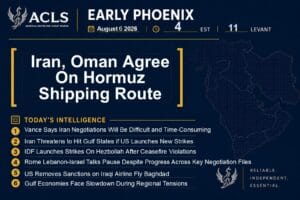
Iran, Oman Agree On Hormuz Shipping Route, Joint Statement Nears Completion
Iran announced it and Oman have agreed on the coordinates of a commercial shipping route through the Strait of Hormuz and are finalizing a joint statement. Tehran said the agreement follows two months of technical, legal, security, and environmental discussions, while stressing the arrangement alone will not guarantee the waterway’s reopening.
Iran Threatens to Hit Gulf States if US Launches New Strikes
Iran warned Gulf states that any new U.S. strikes could trigger attacks on regional energy facilities and other targets. Tehran urged Saudi Arabia, Qatar, and others to push Washington toward diplomacy, while Riyadh called for negotiations and warned it would respond to any threats against its territory.
Pezeshkian Says Communication With Khamenei
Iranian President Masoud Pezeshkian said communication with Supreme Leader Mojtaba Khamenei remains extremely difficult but described him as a major source of strength. Pezeshkian denied resigning or threatening to step down, affirmed full coordination with the armed forces, and accused opponents of spreading claims of divisions within Iran’s leadership following reports Khamenei warned he would accept his resignation if repeated.
=================
★ U.S.A
Vance Says Iran Negotiations Will Be Difficult and Time-Consuming
U.S. Vice President JD Vance said talks with Iran over a potential agreement will be “complex and difficult” and require time. He said Washington aims for the best outcome for Americans and President Trump, predicting lower oil prices, a stronger U.S. position, and that Iran will never obtain a nuclear weapon.
Trump Denies US Munitions Shortage During Pentagon Dispute
President Donald Trump said the U.S. has large ammunition supplies and is expanding production, following reports of a dispute with Defense Secretary Pete Hegseth over weapons shortages linked to the Iran conflict. Trump vowed to punish officials who leaked what he called “treasonous” information about military stockpiles.
US Removes Sanctions on Iraqi Airline Fly Baghdad
The U.S. Treasury removed counterterrorism sanctions on Iraqi airline Fly Baghdad and two Boeing 737 aircraft after an administrative review. Officials said the decision followed major operational changes and was not a shift in U.S. policy toward Iran, the IRGC, or designated groups.
==============
★ GULF STATES
Gulf Shipping Drops After Houthi Claims of Saudi Tanker Attack
Shipping traffic through the Strait of Hormuz and Bab el-Mandeb fell sharply after Yemen’s Houthis claimed missile attacks on Saudi oil tankers. Vessel crossings declined significantly, raising concerns over maritime security and regional trade routes, though Saudi Arabia has not confirmed the reported attacks.
Gulf Economies Face Slowdown During Regional Tensions
Gulf economies are expected to slow in 2026 as regional conflicts, Red Sea disruptions, and Hormuz tensions raise shipping costs and weaken tourism. Oxford Economics projects a 2.4% GDP contraction, while delayed projects and higher living costs add pressure, though strong financial reserves may help limit the impact.
Four Nations Discuss De-escalation and Regional Security Challenges
Saudi Arabia, Pakistan, Egypt, and Türkiye held their fifth regional meeting to discuss de-escalation, security challenges, and diplomatic efforts. The countries supported mediation between Washington and Tehran, emphasized sovereignty and maritime security, and backed protecting key waterways including Hormuz and Bab el-Mandeb to ensure navigation, energy stability, and global trade.
=================
★ ISRAEL
Netanyahu Signals Israel May Act Alone Against Iran If Necessary
Israeli Prime Minister Benjamin Netanyahu signaled Israel could act alone against Iran despite ongoing diplomacy to end the Iran-US war. He vowed to prevent Tehran from acquiring nuclear weapons after citing remarks from Iran’s Revolutionary Guard. Netanyahu praised President Donald Trump as Israel’s closest White House ally but stressed Israel’s security and existence remain non-negotiable.
==============
★ LEBANON
IDF Launches Strikes On Hezbollah After Ceasefire Violations In Lebanon
The Israeli military launched precision strikes against Hezbollah targets in southern Lebanon, saying the attacks responded to repeated ceasefire violations. Israel issued its first civilian evacuation warning since June before the operation, while Lebanese media reported four people were killed in subsequent airstrikes. The strikes coincided with Israel-Lebanon talks in Rome on Hezbollah’s disarmament and border security arrangements.
Two IDF Reserve Soldiers Killed in South Lebanon Blast
Two Israeli reserve soldiers were killed, and four others seriously wounded in an explosion during an IDF operation in southern Lebanon. The military said the incident occurred while troops were clearing a targeted building in Majdal Zoun, after which Israeli forces carried out airstrikes in the area.
Rome Lebanon-Israel Talks Pause Despite Progress Across Key Negotiation Files
The latest Lebanon-Israel talks in Rome ended unexpectedly despite reported progress on political, military and border issues. Conflicting accounts blamed the early suspension on Israeli concerns over leaks, US diplomatic consultations or security incidents in southern Lebanon. Discussions advanced on border arrangements, ceasefire proposals and mechanisms to monitor implementation, with negotiations set to resume the following day.
==============
★ IRAQ
Iraq Struggles to Pay Public Salaries as Strait of Hormuz Crisis Deepens
Iraq is struggling to pay public salaries after oil export disruptions linked to the Strait of Hormuz crisis slashed revenues. Officials warned salary payments could be delayed or issued every 45 days if exports remain constrained. Baghdad is expanding pipeline exports through Türkiye and offering steep discounts on Basra crude to offset losses and attract buyers despite rising regional shipping risks.
==============
★ Disclaimer: This publication is a digest of various news sources compiled by the Early Phoenix team and edited by Rania Kisar. The items are curated, concise summaries of news items hyperlinked within each story. The items and summaries presented do not necessarily represent the views of the American Center for Levant Studies.