

★ IRAN
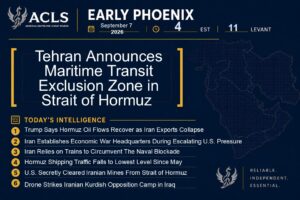
Iran to Declare ‘Prohibited Zone’ Near Strait of Hormuz
Iran plans to declare a “prohibited zone” outside the Strait of Hormuz in coming days, targeting vessels attempting to transit the waterway, Supreme National Security Council chief Mohsen Rezaei said. The move comes amid a U.S. blockade, renewed attacks and sharply reduced shipping traffic through the strategic waterway.
Iran Establishes Economic War Headquarters During Escalating U.S. Pressure
Iran’s Economy Ministry has established an“economic war headquarters” to coordinate responses to sanctions, the U.S. blockade and mounting economic pressures. The initiative targets disruptions to oil exports, foreign currency, trade and fuel supplies, as Tehran faces a sharply weaker rial, nearly 70% inflation and declining oil shipments.
Iran Relies on Trains to Circumvent The Naval Blockade
Iran and China are increasingly relying on railways to sustain trade amid U.S. maritime restrictions and sanctions. Rail traffic has reached nearly 100 trains monthly, while routes through Kazakhstan and Turkmenistan offer alternatives to sea transport. Iran is also expanding rail capacity and using trains for limited oil and LPG shipments to China and Pakistan.
Hormuz Shipping Traffic Falls to Lowest Level Since May
An average of 10 commodity ships crossed the Strait of Hormuz daily over the past 10 days, the lowest level since May, according to Kpler. Traffic fell sharply after U.S. and Iranian strikes on tankers, with only two vessels crossing Saturday and six Sunday, while maritime risks reached extreme levels.
Iran Doubles Unsubsidized Gasoline Prices Amid War Fuel Pressures
Iran will double the price of gasoline sold beyond subsidized quotas to 10,000 tomans per liter from Tuesday, as war-related fuel shortages worsen. Subsidized allocations remain unchanged, while officials cite import disruptions and a daily gasoline deficit of up to 20 million liters. The move risks renewed public anger amid inflation and economic strain.
=================
★ U.S.A
Trump Says Hormuz Oil Flows Recover as Iran Exports Collapse
U.S. President Donald Trump said oil flows through the Strait of Hormuz have recovered to nearly 18 million barrels per day, close to prewar levels. He also claimed Iran’s oil exports had fallen to zero under Washington’s blockade, while U.S. officials cited escorted commercial shipments and ongoing pressure on Tehran.
U.S. Secretly Cleared Iranian Mines From Strait of Hormuz
The U.S. Navy secretly spent four months using special-operations divers, robotic boats and underwater vehicles to clear Iranian mines from Hormuz, reportedly removing about 80 mines by late August. Despite the operation, Iran allegedly laid new mines in September, while renewed attacks pushed shipping traffic to its lowest level since May.
Iran War Raises Jet Fuel Costs, Pressuring U.S. Airlines
The U.S.-Iran war is increasing jet fuel, financing and operating costs for U.S. airlines, with smaller carriers particularly vulnerable due to limited cash reserves and higher debt. Brent crude reached $95.29 a barrel, while longer flight routes and rising insurance and maintenance costs could force airlines to raise fares, cut capacity or absorb lower profits.
=================
★ IRAQ
Drone Strikes Iranian Kurdish Opposition Camp in Iraq
A drone struck an Iranian Kurdish opposition group’s refugee camp in Sulaymaniyah, Iraq’s Kurdistan Region, at around 4:40 a.m. Monday, Rudaw reported. The attack caused material damage but no casualties, according to the report.
Iraqi Shia Factions Seek Trump Support to Retain Their Weapons
Iraqi Shia political forces are reportedly considering a Washington lobbying campaign to persuade the Trump administration to allow Iran-aligned factions to retain weapons under government restrictions. The effort, reportedly backed by Iran, comes as Baghdad shifts from demanding full disarmament toward regulating factional arsenals and strengthening state oversight.
Iraq Boosts Oil Exports Despite Fuel Shortages and Financial Pressures
Iraq has raised oil export capacity above 3 million barrels per day after Iran allowed some Iraqi tankers to cross the Strait of Hormuz. Despite higher exports, Iraq faces gasoline shortages, long fuel queues and financial pressures, highlighting its dependence on oil revenues and vulnerability to disruptions along critical export routes.
=================
★ THE GULF
Saudi Foreign Minister Holds Calls With Iranian, Pakistani Counterparts
Saudi Foreign Minister Faisal bin Farhan discussed regional developments with Iranian Foreign Minister Abbas Araghchi and Pakistani Foreign Minister Ishaq Dar. The talks focused on containing the current crisis, reducing tensions and pursuing peaceful solutions through dialogue and negotiations, while the Saudi-Pakistani call also addressed bilateral relations.
High-Level Qatari Delegation Visits Tehran to Ease Tensions
A senior Qatari diplomatic delegation visited Tehran on Sunday as part of regional efforts to ease tensions, Iranian media reported. The delegation, led by a senior adviser to Qatar’s prime minister and foreign minister, met Iranian Foreign Minister Abbas Araghchi for talks, according to the report.
===========
★ LEBANON
Israel Strikes Southern Lebanon After Hezbollah Drone Attack
Israeli strikes in southern Lebanon killed seven and wounded 20 on Sunday, Lebanese authorities said, after Hezbollah launched two explosive drones at Israeli troops. The IDF said one drone was intercepted and no soldiers were injured, calling the attack a ceasefire violation and striking Hezbollah infrastructure and operatives in response.
===========
★ Disclaimer: This publication is a digest of various news sources compiled by the Early Phoenix team and edited by Rania Kisar. The items are curated, concise summaries of news items hyperlinked within each story. The items and summaries presented do not necessarily represent the views of the American Center for Levant Studies.