

★ THE GULF
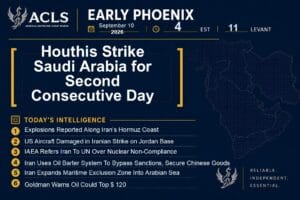
Houthis Strike Saudi Arabia for Second Consecutive Day
Yemen’s Iran-backed Houthis launched ballistic missiles and drones toward Khamis Mushait, Abha and Jazan Wednesday, extending attacks on southern Saudi Arabia for a second day. Saudi authorities issued emergency alerts in Abha and Khamis Mushait before declaring the danger over. Saudi authorities issued emergency alerts in Abha and Khamis Mushait before declaring the danger over. The Saudi-led coalition said it would respond under the kingdom’s right to self-defense, after Saudi aircraft had already carried out dozens of strikes against Houthi positions in Yemen following Tuesday’s attacks.
=================
★ IRAN
Explosions Reported Along Iran’s Hormuz Coast
Explosions were reported Wednesday night on Iran’s Qeshm Island and in Sirik and Minab, all near the Strait of Hormuz. Officials said the explosions heard on Qeshm came from the water, while Iranian media reported projectiles striking several locations in Sirik. The source of the explosions was not immediately clear. Meanwhile, Iran’s IRGC warned it could strike 20 targets for every two or three Iranian targets attacked.
US Aircraft Damaged in Iranian Strike on Jordan Base
Multiple U.S. military aircraft were damaged in overnight Iranian strikes on Muwaffaq Salti Air Base in Jordan, according to CBS reporting. One A-10 Thunderbolt was struck and lost a wing, while roughly eight F-15 fighter jets sustained light damage and were returned to service. The strike followed renewed Iranian ballistic missile attacks on the base amid escalating U.S.-Iran fighting across the region.
Goldman Warns Oil Could Top $120
Goldman Sachs warned escalating attacks in the Persian Gulf and Red Sea could push Brent crude above $120 a barrel. Brent closed above $100 Wednesday, while U.S. consumers have spent an estimated $100 billion more on fuel since the Iran war began.
Iran Rejects Arab League Claims Over Gulf Islands
Iran rejected the Arab League’s latest statement Wednesday and reaffirmed its sovereignty claim over Abu Musa, Greater Tunb and Lesser Tunb, calling it “indisputable.” Tehran also denied interfering in Yemen and blamed regional maritime insecurity on U.S. and Israeli military actions.
Pakistan Presses Iran Over Houthi Attacks
Pakistan conveyed a Saudi warning to Tehran urging Iran to use its influence to halt Houthi attacks on the kingdom, Reuters reported. An Iranian official confirmed receiving the message but said Tehran does not control the Houthis. Pakistan is seeking to prevent the escalation from triggering a wider regional conflict.
IAEA Refers Iran To UN Over Nuclear Non-Compliance
The IAEA board voted 23-3 to refer Iran to the UN Security Council over its failure to cooperate with a probe into undeclared nuclear material. Iran rejected the move, citing ongoing war, while the IAEA says Tehran holds 440.9kg of uranium enriched to 60%.
Iran Uses Oil Barter System To Bypass Sanctions, Secure Chinese Goods
Iran has used a barter-like system to exchange oil proceeds for billions of dollars in Chinese goods, including medicines, vehicles, communications equipment and air-defense systems. Sources estimate $2–2.5 billion flowed through a special-purpose vehicle last year, helping Tehran bypass international banking channels and shielding Chinese firms from sanctions scrutiny.
Iran Expands Maritime Exclusion Zone Into Arabian Sea
Iran has expanded its planned maritime exclusion zone beyond the Strait of Hormuz into parts of the Gulf of Oman and Arabian Sea. The Revolutionary Guards warned vessels entering without coordination could face penalties, including being barred from Hormuz and losing navigation-related services such as insurance. Tehran says the move responds to the U.S. blockade.
=================
★ IRAQ
Oil Tanker Attacked By Drone At Al Amaya Port
An Iraqi security source said an Iranian drone attacked a Panama-flagged foreign oil tanker in Iraqi waters near Al Amaya Port, causing a fire that rescue teams extinguished. No injuries were reported. The incident came amid escalating Iran-US tensions and attacks on oil tankers around the Strait of Hormuz.
Iraq’s ports seek solutions to mitigate Hormuz closure impacts
Iraq’s General Company for Ports met with GIZ experts to assess the impact of the Strait of Hormuz closure on trade, maritime transport and supply chains. Officials discussed contingency measures, stronger public-private coordination and logistics resilience to maintain trade flows and limit economic effects on Basra and Iraq.
=================
★ Disclaimer: This publication is a digest of various news sources compiled by the Early Phoenix team and edited by Rania Kisar. The items are curated, concise summaries of news items hyperlinked within each story. The items and summaries presented do not necessarily represent the views of the American Center for Levant Studies.