

By Rania Kisar
Co-Founder and Research Director, American Center for Levant Studies | M.A., Global Security
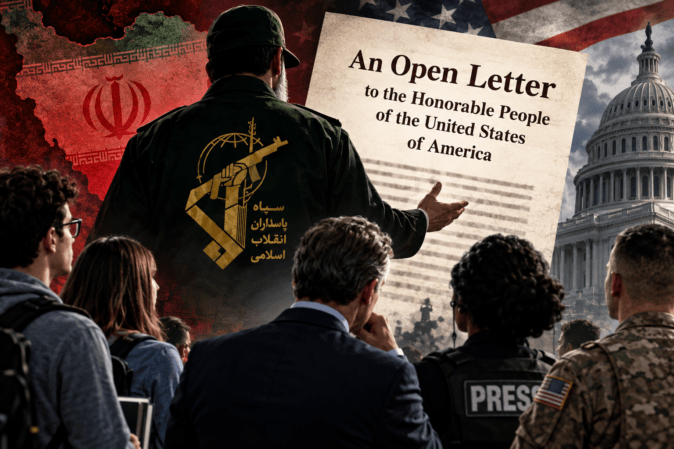
On September 29, Iran’s Islamic Revolutionary Guard Corps did something unusual. It published a lengthy open letter addressed not to Washington but to “the honorable people of the United States,” and particularly to American scholars, students and journalists. I checked each of its more than 300 factual assertions. The pattern is more effective than pure fabrication: verifiable facts and genuine grievances are mixed with unsupported, misleading and false claims, and opinion and prediction are repeatedly presented as fact.
Five weeks before the midterms, the letter is an unusually open attempt by the IRGC to influence American voters. It recasts “Death to America” as a curse on leaders Americans themselves elected, rewrites decades of history with Iran only as victim, and turns real American grievances into instructions on whom to remove. And it comes from an organization whose record, at home and on American soil, shows exactly why it is so dangerous to the United States.
The letter first separates Americans from their leaders. “Death to America,” it insists, really means “Death to the crimes perpetrated by the American elite.” But that “elite” is whoever Americans elect: eight presidents from both parties have held office since the chant began in 1979.
Next, it rewrites history. The letter catalogs American wrongs since 1953, from the CIA-backed coup against Mohammad Mosaddegh to the downing of Iran Air Flight 655, which killed 290 civilians. Those events are real. But the account omits the 52 Americans held hostage for 444 days, the 241 U.S. service members killed in the 1983 Beirut barracks bombing that a U.S. federal court found Iran responsible for, and the 603 American troop deaths in Iraq the Pentagon attributed to Iran-backed militants. It mourns Flight 655 but not the 176 people killed in 2020 when the IRGC itself shot down a Ukrainian airliner over Tehran. A history in which only one side ever acted is not history. It is a prosecutor’s brief.
Then it borrows American grievances. Veteran suicides, poverty, campus protests over Gaza and the “No Kings” rallies are recast as signs of a national awakening. Service members are told their wars are meaningless; academics are urged to refuse military-related research. This is not diplomacy. It is audience segmentation.
Finally, it tells Americans what to do with their votes. “Remove from power the evil, deceitful, and violent politicians,” it instructs, because “now is the time, as the American political system is at its weakest.” It warns of worldwide fury and economic catastrophe, then adds: “You, the American people, have the power to forestall this grim fate.” A foreign military organization predicts disaster, then tells voters which leaders to remove to avoid it. Nothing here is hacked, forged or hidden. It is coercive political messaging, delivered under the IRGC’s own name.
That is new only in its openness. During the 2020 election, Iran-based actors posing as the Proud Boys sent threatening emails to American voters. In 2024, three IRGC employees were charged in a hack-and-leak operation against a presidential campaign. What changed in 2026 is that the IRGC dropped the disguise.
None of this means everything in the letter is false. On the war’s first day, a U.S. strike hit an elementary school in Minab and killed more than 150 people, including around 120 schoolchildren. A U.N.-backed fact-finding mission found reasonable grounds to believe the strike amounted to a war crime. Americans outraged by Minab are right to be. But influence campaigns rarely run on pure invention. They start with a true grievance and use it to carry claims that cannot stand on their own: that 9/11 was a false-flag operation, that America created ISIS, that Iran enjoys “the fastest rate of scientific progress in the world.” Outrage at Minab does not make the IRGC a trustworthy narrator.
That matters most when the letter turns to violence. “Death to America,” the IRGC explains, is only “a prayer for the eradication of the diabolical ruling elite whose seat of power is the White House.” That should alarm, not reassure. The letter claims there is “not a single verifiable instance” of IRGC violence against civilians. Yet the IRGC’s own missile killed all 176 people aboard that Ukrainian airliner. A U.N. fact-finding mission found that violations during Iran’s 2022 crackdown on the “Woman, Life, Freedom” protests amounted to crimes against humanity. The letter blames the CIA for the more than 2,300 Iranians it says died in January’s unrest, yet Iran’s own president said his government was “ashamed before the people.” And on American soil, a Brooklyn jury in March convicted Asif Merchant, who admitted at trial that the IRGC sent him to arrange political assassinations, with President Trump a possible target. Two men received 25-year sentences for a plot to murder Masih Alinejad, an Iranian-American journalist in New York, which the Justice Department says was directed by the IRGC. Prosecutors have also charged an IRGC member with plotting to murder former national security adviser John Bolton. “Death to the elite” has already meant real plots against real people on American soil.
Even the letter’s friendliness carries a threat. A footnote clarifies that “Iranian” means only “true, honest Iranians,” not those who have “sold their soul to the devil,” the language of an organization that hunts its critics abroad. And its invitation for Americans to visit Iran and see for themselves comes from a state the U.S. State Department accuses of wrongfully detaining foreign and dual nationals as bargaining chips.
The letter’s timing speaks for itself. It appeared two days after British police arrested five men near RAF Fairford, an air base American bombers have used to strike Iran. Prime Minister Andy Burnham has cited “strong indications” that Iran played a role, and police have since arrested a dual British-Iranian national on suspicion of preparing terrorist acts. On October 2, British authorities charged two Iranian nationals with preparing an attack on Manchester’s Jewish community, allegedly in contact with someone who may be in Iran. None of these allegations has been proven in court. But in the same week the IRGC asked Americans for their trust, British police were investigating possible Iranian links to a plot against a base that hosts American forces.
The letter’s final pages reveal what the IRGC actually wants. It vows to keep fighting for the “liberation of humanity” and closes by inviting Americans to stand at Iran’s side “as we are led by Mahdi and Christ toward final victory.” That is not an offer of coexistence between equals. It is a recruitment pitch for an ideological project, from an organization that persuades when it can and plots violence when it can’t.
Americans are entitled to debate this war, criticize their government and vote out politicians they believe have failed them. Those choices belong to Americans, not to Tehran. To the scholars, students and journalists the IRGC chose as its audience: before you cite a single line of this letter, remember who wrote it, and what it has tried to do on American soil when persuasion wasn’t enough.