

★ IRAN
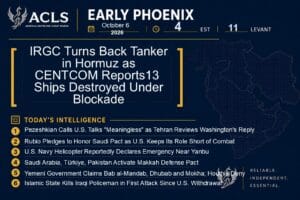
IRGC Turns Back Tanker in Hormuz as CENTCOM Reports 13 Ships Destroyed Under Blockade
A tanker entering the Strait of Hormuz near Oman’s coast turned back Monday after the IRGC threatened to target it, according to UK Maritime Trade Operations, which also reported three vessels struck by unknown projectiles in recent days. U.S. Central Command said its forces have destroyed 13 commercial vessels over the past 12 weeks, disabled three and redirected 130 since the blockade of Iranian ports resumed on July 14. IRNA and Fars reported explosions near Qeshm Island and Sirik on Sunday evening; the cause was not confirmed, though Fars suggested Iranian fire on “offending vessels.” IRGC adviser Ali Fadavi said on state television Sunday that U.S. forces had moved more than 1,000 km from Iran’s borders and that no U.S. warships remain in the Gulf, the Strait of Hormuz, the Gulf of Oman or the northern Indian Ocean, and he threatened any location used to launch attacks on Iran. His deployment claims have not been independently verified. Lawmakers are also advancing a bill to assert Iranian control over Hormuz traffic, according to Tasnim.
Iran’s Security Chiefs Warn Next U.S. Move Will Open “New Fronts”
Supreme National Security Council Secretary Mohsen Rezaei said Monday that the enemy’s next mistake will open “new fronts” and bring “bigger surprises,” while armed forces chief of staff Maj. Gen. Ali Abdollahi warned that any new war “will engulf everyone” and that any U.S. action, directly or at Israel’s urging, would bring immediate strikes on American interests “without limitation.” Abdollahi said Iran is not waiting for the outcome of the U.S. midterm elections. Army commander Maj. Gen. Amir Hatami separately promised a “crushing response.”
Pezeshkian Calls U.S. Talks “Meaningless” as Tehran Reviews Washington’s Reply
President Masoud Pezeshkian said negotiations with the United States are “meaningless,” arguing Washington has attacked Iran three times after talks and seeks to overthrow the Islamic Republic, state news agency IRNA reported. Deputy Foreign Minister Kazem Gharibabadi said Sunday the U.S. response to Tehran’s proposal on reopening the Strait of Hormuz is under review through “relevant channels,” while spokesman Esmail Baghaei said the counterproposal tracked earlier U.S. nuclear demands and that reopening the strait requires lifting sanctions; he also said countries that let the U.S. and Israel use their territory for attacks on Iran must be held accountable. The U.S. Treasury warned foreign financial institutions that any still transacting with sanctioned Iranian banks could be targeted without advance notice. Pezeshkian on Monday nominated Mehrdad Akhlaghi Ketabchi, a missile-industry veteran, as defense minister, filling a post vacant since Aziz Nasirzadeh was killed in U.S.-Israeli strikes in February, Iran International reported.
=================
★ YEMEN
Rubio Pledges to Honor Saudi Pact as U.S. Keeps Its Role Short of Combat
Secretary of State Marco Rubio said Monday that Washington has a defense and security agreement with Saudi Arabia and “we intend to live by it,” adding that the kingdom has a right to defend itself against Houthi attacks and that Yemeni forces are seeking to recover lost territory. President Trump separately expressed confidence that the offensive would succeed. Washington has nonetheless twice rejected Saudi requests for U.S. airstrikes, most recently after an October 1 call between Saudi Defense Minister Prince Khalid bin Salman and Defense Secretary Pete Hegseth, Axios reported. U.S. officials described American help as everything short of direct combat, said CENTCOM sees strikes in Yemen as a distraction from Iran, and said the position could change if the operation runs into trouble. Axios reported the U.S. supplied Riyadh with more than 200 Houthi targets in the two weeks before October 2; CNN reported on September 10 that more than 100 U.S. advisers were providing intelligence and targeting support in the kingdom.
Yemeni Government Claims Bab al-Mandab, Dhubab and Mokha; Houthis Deny
Yemen’s internationally recognized government said Monday its forces had retaken the Dhubab district, Dhubab airport and the Red Sea port of Mokha on the first full day of “Operation Dawn of Yemen,” announced Sunday by Presidential Leadership Council Chairman Rashad al-Alimi. Military spokesman Majed al-Nazili said forces cut the Dhubab–Mokha road and took control of the Bab al-Mandab area, and the government announced a “strategic offensive” on Sanaa. AP, citing anonymous Yemeni officials, reported that government-allied forces retook Dhubab and captured the towns of Bab and Hadeid, with witnesses describing government tanks entering the towns. Houthi-aligned media denied the advances, and the Mokha and wider strait claims have not been independently verified. The status of Mayyun (Perim) Island is unclear. The Houthis seized Mokha on September 10 and Mayyun on September 11.
Houthis Take al-Turbah and Alimi’s Home as Taiz Siege Tightens
Houthi fighters entered al-Turbah, the main city of Taiz’s al-Hujariyah region, on October 4 without a fight after government forces withdrew, the first time the group has held the city since the war began in 2014, a local security official told Xinhua. The Houthis also seized al-Safiya, cutting the main road between Taiz and Aden and effectively encircling Taiz, and reached the home area of Parliament Speaker Sultan al-Barakani. On Monday, as Alimi’s offensive got underway, Yemeni government and local sources reported that Houthi fighters entered al-A’loum in al-Mawasit district and seized Alimi’s house; Houthi media claimed the whole district. Alimi has lived outside Yemen since 2014. AFP reported Sunday, citing sources on both sides, that fighting in and around Taiz province had killed more than 70 people in a single day; the toll has not been independently verified.
=================
★ GULF STATES
U.S. Navy Helicopter Reportedly Declares Emergency Near Yanbu
A U.S. Navy MH-60R Seahawk, call sign VVHR512, reportedly declared an emergency over the Red Sea near Yanbu at about 5:20 p.m. ET Monday, BNO News reported, citing Flightradar24 data. The helicopter displayed an altitude of about 475 feet before the reading dropped to zero and public tracking stopped. No official statement on the aircraft’s status or the cause of the emergency had been located, and loss of tracking alone does not establish a crash.
Red Sea Energy Risk Persists Despite Coalition Gains
UKMTO reported multiple explosions near a tanker south of Mokha on Sunday, and the Houthis retain missiles, drones and naval mines able to threaten shipping from Hodeidah and the highlands. An energy-sector source told AFP that Saudi Arabia’s East-West pipeline was struck again at a Khurais pumping station, halting flows, while Reuters and Bloomberg reported oil still moving; the line feeds the Red Sea terminal at Yanbu. France is deploying troops, radars and defense systems to Yanbu, and Britain has sent an RAF Voyager tanker. Brent settled $1.93 lower at $100.32, a decline Reuters attributed to rising Middle East exports and a G7 stock release, despite continued concerns about the fighting in Yemen.
Coalition Targets Houthi Arsenal as Houthis Claim Strikes on Riyadh
Coalition spokesman Maj. Gen. Turki al-Maliki said 100 fighter jets took part in the opening of Operation Dawn of Yemen and that coalition forces had destroyed 324 “high-value targets” since it began. He said strikes also destroyed a ballistic-missile launcher in Sanaa and a Saada mountain depot holding 20 ballistic missiles, and that naval forces destroyed weapons depots, explosive-boat storage and naval mines in Hodeidah. Houthi military spokesman Yahya Saree claimed drone and missile attacks on King Khalid International Airport in Riyadh, the Aramco refinery in Rabigh and sites in southern Saudi Arabia, and warned airlines that Saudi airspace outside Makkah and Madinah is unsafe. An AFP journalist and residents heard a powerful explosion in northern Riyadh not far from the airport; its cause was not established. Neither side’s damage claims have been independently verified, and Saudi authorities have not confirmed the specific strikes Saree claimed, though the Foreign Ministry condemned repeated Houthi attacks on Riyadh and other cities.
Saudi Arabia, Türkiye, Pakistan Activate Makkah Defense Pact
Saudi Arabia, Türkiye and Pakistan agreed Monday to move immediately to the practical implementation of their collective-defense commitments and provide agreed forces for rapid deployment to the kingdom, after an emergency committee meeting in Riyadh that condemned the attempted targeting of Makkah and Madinah. No troop numbers or timelines were disclosed. Pakistani and regional officials told Reuters last week that Turkish and Pakistani equipment is already being used by the kingdom in Yemen, though a Pakistani official said Islamabad had not decided to send troops into Yemen in a fighting capacity. On Friday, Pakistani Foreign Minister Ishaq Dar said Iran had distanced itself from the Houthis and proposed a political track with the group as an alternative to military action, describing it as an informal exchange between foreign ministers to be discussed in Riyadh.
U.S. Approves $1.4 Billion in Proposed Arms Sales to UAE, Kuwait
The State Department approved a proposed $1 billion sale to the UAE of up to 10,000 Advanced Precision Kill Weapon System guidance kits, which convert unguided rockets into precision munitions suited to downing drones. It also approved a proposed $400 million package of Patriot missile repair-and-return services for Kuwait. Both states have been repeatedly targeted by Iranian drones and missiles since the war began in February.
=================
★ IRAQ
Islamic State Kills Iraqi Policeman in First Attack Since U.S. Withdrawal
Islamic State militants attacked a federal police post near Hawija, about 70 km southwest of Kirkuk, on Monday, killing at least one policeman and wounding four, two security sources told Reuters. There was no claim of responsibility. It is the first reported Islamic State assault on Iraqi security forces since U.S. forces completed their withdrawal from Iraq on September 30; Washington has said it will continue targeted training and intelligence support.
=================
★ ISRAEL
Shin Bet Joins flydubai Probe as Trump Points to Iran and Security Gaps Emerge
Shin Bet interrogators have flown to the UAE to take part in questioning Omani co-pilot Hamam al-Hammami, who tried to crash flydubai Flight FZ1073 on September 30. Channel 12 reported he told interrogators he acted “in revenge for Gaza”. President Trump said he personally believes Iran was responsible, diverging from Vice President JD Vance and Israeli officials who assess Hammami acted alone. CBS News, citing Israeli sources, reported that Israel scrambled fighter jets and was prepared to shoot down the plane before it diverted to Saudi Arabia. At home, a Transportation Ministry letter confirms its own responsibility for inbound-flight security, contradicting Minister Miri Regev, and most Arkia and Israir flights use wet-leased foreign crews outside the Shin Bet’s security envelope.
Netanyahu Says Iran’s Regime Is “Fighting for Survival” at October 7 Ceremony
Speaking at the state ceremony marking three years since the October 7 attack, Netanyahu said Iran’s leadership is weaker than at any point since its founding and will ultimately disappear, describing October 7 as the opening stage of an Iranian-led effort to destroy Israel. Tehran’s military leadership answered with warnings of its own. The ceremony came three weeks before Israel’s October 27 election; a Channel 12 poll shows continued deadlock, with the pro-Netanyahu bloc at 49 seats and neither bloc able to form a coalition.
=================
★ SYRIA
Israel Resumes Work on “Sufa 53” Line Inside Syria, Drawing Arab Condemnation
Israeli forces brought in heavy machinery Sunday to resume fortification and excavation work on the “Sufa 53” line near Asha and Rafid in southern Quneitra, a project begun in 2022 that includes an eight-meter military road, five-meter earthen berms, trenches and observation posts inside the buffer zone. Syria’s Foreign Ministry called it a flagrant breach of the 1974 Disengagement Agreement. Qatar, Jordan and Kuwait condemned the work Sunday, and Türkiye and Egypt followed Monday, with Ankara naming the Sufa 53 line directly. Residents of Asha appealed to UN observers (UNDOF) to intervene. Separately, Israeli troops fired on two unarmed men approaching an army post in the buffer zone Monday, wounding one, the IDF said.
Damascus Signs Development Deal With UAE’s Eagle Hills
Syria’s ministries of public works and tourism signed a framework agreement with Emirati developer Eagle Hills to build urban and tourism complexes in Damascus and Latakia, in a ceremony attended by President Ahmed al-Sharaa. The deal adds to a string of Gulf-backed reconstruction and investment announcements as Damascus courts foreign capital.
=================
★ Disclaimer: This publication is a digest of various news sources compiled by the Early Phoenix team. The items are curated, concise summaries of news items hyperlinked within each story. The items and summaries presented do not necessarily represent the views of the American Center for Levant Studies.