

★ GULF STATES
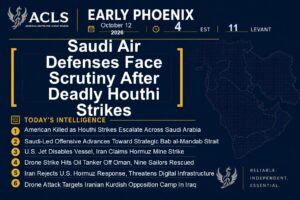
Saudi Air Defenses Face Scrutiny After Deadly Houthi Strikes
RIYADH — Iran-backed Houthi attacks and attempted strikes against Saudi Arabia escalated over the weekend, with four reported projectile impacts at or near international airports in Riyadh and Dammam and three additional threats intercepted by Saudi defenses. The attacks killed 14 people, including an American citizen, and injured at least 320, according to Saudi authorities and Reuters.
Saturday’s strike on Riyadh’s King Khalid International Airport ultimately killed 13 people and injured 309. Among the dead were an Egyptian flight attendant preparing for her wedding, a Syrian widowed mother of four, and an Indian pilgrim traveling with his family for Umrah. The fatalities also included Saudi, Bangladeshi, Jordanian, Palestinian, and Sudanese nationals. Secretary of State Marco Rubio confirmed the American death. A second strike Sunday killed a Pakistani resident and injured 11.
The attacks extended across Saudi territory. A projectile landed near Dammam’s King Fahd International Airport Saturday, followed by a separate strike on the airport Sunday evening. Saudi forces reported intercepting a cruise missile near Riyadh, a ballistic missile targeting Khamis Mushait, and a drone over the Eastern Province. Houthi spokesman Yahya Saree also claimed attacks against two Saudi Aramco facilities, which remain unverified, and warned airlines against using Saudi airports and airspace.
Saudi-Led Offensive Advances Toward Strategic Bab al-Mandab Strait
Saudi-backed Yemeni forces continued Operation Dawn of Yemen, supported by sustained coalition airstrikes. On October 9, coalition spokesman Maj. Gen. Turki al-Maliki announced the destruction of 136 Houthi military targets, including elements of the group’s ballistic missile network. Yemeni government forces separately claimed more than 2,750 targeting operations over 24 hours. Neither figure has been independently verified.
Along the Red Sea coast, government-aligned forces reported securing the strategic Kahbub heights and recapturing positions overlooking Bab al-Mandab. Military sources also claimed the liberation of Perim Island, although control remains disputed. Yemen’s government acknowledged that operations to secure the strait were continuing. The reported advances could constrain Houthi positions near this critical maritime chokepoint without eliminating the threat to shipping.
American Air Defenses Face Mounting Pressure
Repeated strikes against Riyadh raise serious questions about Saudi Arabia’s American-supplied air-defense network. A Reuters correspondent reported that no early-warning alerts sounded before Saturday’s deadly attack. Saudi Arabia operates Patriot and THAAD systems, but the projectile’s flight profile and the circumstances of its penetration remain undetermined. The Associated Press previously reported that Riyadh had sought assistance from international partners amid dwindling interceptor inventories. The attacks expose mounting pressure on Saudi defenses; they do not establish a technical failure of either American-made system.
Washington Weighs Intervention
Following the American fatality, President Donald Trump said Washington was considering joining Saudi military strikes against the Houthis. No decision had been announced by Sunday. The FAA also issued a safety advisory for U.S. operators flying into or over Saudi Arabia.
Drone Strike Hits Oil Tanker Off Oman, Nine Sailors Rescued
A drone strike hit the oil tanker MT Petro Dolphin near Sohar port in Oman on October 12, prompting authorities to evacuate its crew. India’s shipping minister said nine of 11 Indian sailors were rescued, while two remained missing. Damage and potential environmental impacts remain unclear, raising concerns over maritime security, shipping insurance costs and Gulf energy supplies.
=================
★ IRAN
Saudi and Iranian Foreign Ministers Discuss De-escalation
Saudi Foreign Minister Prince Faisal bin Farhan and Iranian Foreign Minister Abbas Araghchi held a telephone conversation Sunday to discuss the escalating regional conflict and efforts to reduce tensions, according to Reuters, citing Saudi state media. It was their first publicly reported contact since the latest intensification of Houthi attacks against Saudi Arabia. Araghchi subsequently stated that Tehran was prepared to facilitate dialogue between Saudi Arabia and Yemen.
U.S. Jet Disables Cargo Ship as Hormuz Tanker Burns
A U.S. fighter jet struck the Panama-flagged M/V Ocean Molica in the Gulf of Oman on October 10, disabling its propulsion after the vessel allegedly ignored warnings and attempted to breach Washington’s naval blockade of Iran. CENTCOM reported no crew injuries and said U.S. forces have disabled four commercial vessels, turned back 135 ships, and destroyed 10 tankers linked to the IRGC’s shadow fleet since July 14. Separately, an outbound tanker caught fire in the Strait of Hormuz after being struck on its port side. Iran’s Revolutionary Guards claimed it had struck a naval mine, but Britain’s UKMTO reported an unidentified projectile; the crew survived.
Iran Rejects U.S. Hormuz Response, Threatens Digital Infrastructure
Iran’s Supreme National Security Council Secretary Mohsen Rezaei declared Sunday that Washington’s response to Tehran’s seven conditions for reopening the Strait of Hormuz was insufficient. In an interview with Press TV, Rezaei claimed the United States had accepted some conditions but left others unresolved. He ruled out reopening the waterway or resuming negotiations until Iran’s demands were met. Rezaei also threatened U.S.-linked undersea communications cables, data centers, and artificial intelligence facilities across the region if large-scale hostilities resumed, estimating their value at more than $2 trillion.
=================
★ IRAQ
Drone Attack Targets Iranian Kurdish Opposition Camp In Iraq
A drone attack targeted an Iranian Kurdish opposition camp in Koya, east of Erbil in northern Iraq, two security sources told Reuters. No casualties were reported.
Iraq’s Non-Oil Revenues Rise 23.5% To Record $5.8 Billion
Iraq’s federal revenue allocation oversight authority reported non-oil revenues of $5.8 billion by the end of July 2026, up 23.5% from $4.7 billion a year earlier. Non-oil income accounted for 22% of federal revenues. The figures remain preliminary pending verification, while authorities pursue electronic tax collection, customs modernization and improved state property revenue collection.
=================
★ Disclaimer: This publication is a digest of various news sources compiled by the Early Phoenix team and edited by Rania Kisar. The items are curated, concise summaries of news items hyperlinked within each story. The items and summaries presented do not necessarily represent the views of the American Center for Levant Studies.