

★ ARABIAN PENINSULA
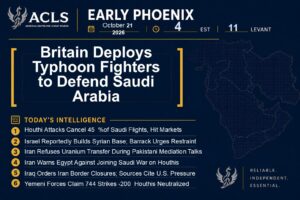
Britain Deploys Typhoon Fighters to Defend Saudi Arabia
Britain announced Tuesday that Royal Air Force Typhoon fighters would conduct defensive missions over Saudi Arabia to protect cities, civilians, and critical infrastructure against Houthi attacks. London also extended aerial refueling support and pledged military advisers and transport aircraft. British officials described the deployment as defensive, without announcing offensive operations against the Houthis.
Saudi Arabia Intercepts Houthi Missile, Drone Targeting Riyadh
Saudi air defenses intercepted a Houthi ballistic missile targeting Riyadh and a drone over the capital region Tuesday, according to Saudi Gazette. Emergency warnings were issued, and AFP journalists reported hearing explosions during the missile interception. The Saudi-led coalition said it subsequently destroyed the missile launch platform in Yemen. No casualties or damage from Tuesday’s attacks were reported.
Yemeni Forces Claim 744 Strikes, 200 Houthis Neutralized
Yemen’s government forces reported conducting 744 attacks against Houthi positions over 24 hours on Tuesday, using aircraft, drones, artillery, rockets, and snipers. The military claimed approximately 200 Houthi fighters were neutralized and 90 vehicles and military assets were destroyed or damaged, with operations concentrated around Taiz and other fronts.
Houthi Attacks Cancel 45% of Saudi Flights, Hit Markets
More than 45% of scheduled departures from Saudi airports have been canceled since October 8 following Houthi attacks, according to aviation analytics firm Cirium, Reuters reported Tuesday. Air France-KLM suspended Riyadh flights through November 7, while Lufthansa extended cancellations through November 18. Saudi Arabia’s benchmark stock index fell 1.7% Tuesday, and the kingdom postponed its flagship investment conference until next year. Financial Times reported private jet charter prices surged more than 50% as travelers sought alternatives.
=================
★ ISRAEL
Israel Reportedly Builds Syrian Base; Barrack Urges Restraint
Syrian outlet Syria 360 reported that Israeli helicopters transported weapons and advanced equipment to Jabal al-Arab in Suwayda province over 72 hours, reportedly preparing an intelligence and early-warning base. Separately, the Syrian Observatory for Human Rights documented more than 13 Israeli ground and aerial incursions across southern Syria within 48 hours. Speaking at the Global Security Forum in Doha, U.S. envoy Tom Barrack said Syrian President Ahmed al-Sharaa was willing to reach an understanding with Israel, including a nonaggression agreement that could pave the way for normalization of relations. Barrack also called for an end to Israeli military operations inside Syria.
Israel Prepares for Possible Iranian Attack During October 27 Election
Israel’s Central Elections Committee has examined contingency plans for an Iranian missile attack when polls open October 27, Israel Hayom reported. The IDF, Shin Bet, and police have coordinated election-security measures, while a separate OSINT investigation identified suspected Iranian-linked accounts spreading election misinformation. However, senior Israeli security officials told Israel Hayom Tuesday that direct Iranian military action before the vote was unlikely, although interference through other means remained a concern.
Israel, Lebanon Hold Security Talks at U.S. Military Headquarters
Israeli and Lebanese delegations met Tuesday at U.S. Central Command headquarters in Tampa, Florida, to discuss implementation of a U.S.-brokered security framework, two Israeli military sources told The Jerusalem Post. The discussions include Hezbollah’s disarmament and Israeli military operations in Lebanon. President Joseph Aoun has demanded an end to Israeli attacks and withdrawal of Israeli forces. The talks are expected to continue Wednesday; no agreement has been announced.
=================
★ IRAN
Iran Refuses Uranium Transfer During Pakistani Mediation Talks
Iran’s Supreme National Security Council Secretary Mohsen Rezaei told Pakistani army chief Asim Munir Tuesday that “not a single particle” of enriched uranium would leave Iran, ruling out negotiations with Washington until Tehran’s conditions for rebuilding trust are met. President Masoud Pezeshkian demanded an end to U.S. threats and sanctions, while Parliament Speaker Mohammad Bagher Ghalibaf reiterated Iran’s seven conditions for renewed talks. Munir announced the reopening of the Iran–Pakistan border, but IRGC-affiliated Fars reported crossings remained closed Tuesday evening, with limited trade expected Wednesday.
Iran Warns Egypt Against Joining Saudi War on Houthis
Iranian Foreign Minister Abbas Araghchi warned Tuesday that Egyptian military intervention against Yemen’s Houthis would complicate the conflict, Reuters reported. Egypt’s parliament postponed until October 26 a vote on President Abdel Fattah el-Sisi’s request to authorize military assistance to Saudi Arabia. The Houthi-controlled parliament separately warned that Egyptian involvement could threaten Egypt’s national security. Cairo says any military assistance would be defensive, while some Egyptian lawmakers oppose the proposed deployment.
=================
★ IRAQ
Iraq Orders Iran Border Closures; Sources Cite U.S. Pressure
Iraq ordered the al-Sheib border crossing with Iran closed from Wednesday morning, October 21, until further notice, with additional crossings expected to close gradually, according to 964media and Al Jazeera. The restrictions cover passenger and commercial traffic. An Iraqi government source told Al-Ain that Washington had pressured Baghdad to close its border with Iran as part of an economic pressure campaign, reportedly proposing that only two crossings remain open. Iraqi authorities have not publicly confirmed the U.S. role or explained the broader closure plan.
=================
★ Disclaimer: This publication is a digest of various news sources compiled by the Early Phoenix team and edited by Rania Kisar. The items are curated, concise summaries of news items hyperlinked within each story. The items and summaries presented do not necessarily represent the views of the American Center for Levant Studies.