

★ ISRAEL
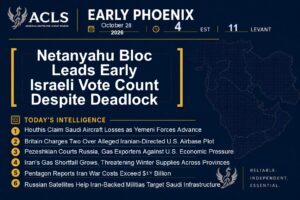
Netanyahu Bloc Leads Early Israeli Vote Count Despite Deadlock
Israel’s preliminary election count showed Prime Minister Benjamin Netanyahu’s bloc holding a projected 63 Knesset seats against 49 for Gadi Eisenkot’s opposition, with eight seats for the predominantly Arab Joint List, according to The Times of Israel. The figures, based on 25.2% of ballot boxes counted, diverged sharply from exit polls suggesting a parliamentary deadlock. Likud remained the largest party. However, the results are provisional, with additional ballots and the 3.25% electoral threshold potentially changing the distribution. Turnout reached 77.7%.
=================
★ IRAN
Britain Charges Two Over Alleged Iranian-Directed U.S. Airbase Plot
Two men appeared in a London court Tuesday over suspected Iranian intelligence activity targeting RAF Fairford, which hosted U.S. bombers striking Iran. Prosecutors accused Mohmed Abdulkarim, 24, of assisting foreign intelligence and Nouman Essghir, 24, of reconnaissance. Investigators allege a handler called “Ali” directed five men to transport vans containing petrol to the base. One suspect alerted police after being told a van contained a bomb. Tehran denies involvement.
Khamenei Demands Hormuz Control as Qatar Presses for Reopening
Iranian Supreme Leader Mojtaba Khamenei reportedly instructed security chief Mohsen Rezaei to maintain control of Hormuz and uphold Iran’s conditions for ending the war. Following talks with Saudi Arabia, Turkey, and Pakistan, Rezaei advocated regional security without foreign intervention. Qatar demanded that Tehran reopen the strait and stop threatening Gulf neighbors. Separately, Iran’s military reported that an unidentified tanker struck mines and caught fire in restricted waters, an incident not independently confirmed.
Pezeshkian Courts Russia, Gas Exporters Against U.S. Economic Pressure
Iranian President Masoud Pezeshkian urged gas exporters in Moscow to counter U.S. sanctions, blockades, and attacks on Iranian energy infrastructure. During a separate meeting, Russian President Vladimir Putin reaffirmed Moscow’s commitment to constructing Iran’s Bushehr nuclear power plant and reported bilateral trade growth of 10.4% during January–August 2026. Pezeshkian also met Qatar’s emir to discuss energy cooperation and regional relations.
Iran’s Gas Shortfall Grows, Threatening Winter Supplies Across Provinces
Iran’s gas shortfall has increased by 130 million cubic meters year-on-year, threatening winter supplies, National Iranian Gas Company official Houshang Seidali warned Wednesday. Eleven provinces could face shortages, particularly North Khorasan, Mazandaran and Golestan. Some capacity at refineries damaged during the war has been restored.
Gulf States Pursue Regional Deal To Prevent Renewed Iran War
Gulf states are developing a regional agreement to prevent renewed U.S.-Iran war, The Guardian reported Wednesday. Proposals include reopening the Strait of Hormuz within four days of sanctions relief, addressing Yemen’s conflict, and establishing regional security arrangements. Washington seeks further Iranian concessions, including nuclear inspections, while Tehran advocates a non-aggression pact covering all six Gulf Cooperation Council members.
Pentagon Reports Iran War Costs Exceed $47 Billion
The Pentagon estimates the U.S. military has spent over $47 billion on the Iran war, more than 25% above its July estimate. Ammunition replacement accounts for over $29 billion, while equipment replacement exceeds $6 billion. The figures do not clearly establish whether repairs to U.S. bases damaged by Iranian missile and drone attacks are included.
=================
★ARABIAN PENINSULA
Houthis Claim Saudi Aircraft Losses as Yemeni Forces Advance
Houthi spokesman Yahya Saree claimed ballistic missiles destroyed two Saudi military transport aircraft at Najran Airport and King Khalid Air Base. He also claimed strikes on facilities in Riyadh, Abha, and Ras Tanura. Saudi authorities confirmed missile interceptions but not the aircraft losses. Meanwhile, Yemeni government forces reported 1,382 strikes, approximately 440 Houthis neutralized, and 146 military assets destroyed or disabled during Operation Yemen Dawn. Government-aligned forces also claimed strategic gains near Bab el-Mandeb. Battlefield claims remain unverified.
Russian Satellites Help Iran-Backed Militias Target Saudi Infrastructure
Russian spy satellites reportedly helped Iranian-backed Houthis and Iraqi militias conduct precision strikes on Saudi oil pipelines and military facilities, the Associated Press reported. Intelligence firm AURORAH identified satellite activity matching 40 attacks between July and October. Saudi officials and a Houthi leader said Russian and Chinese intelligence capabilities supported targeting through Iranian advisers, though direct intelligence transfers remain unverified.
=================
★ Disclaimer: This publication is a digest of various news sources compiled by the Early Phoenix team and edited by Rania Kisar. The items are curated, concise summaries of news items hyperlinked within each story. The items and summaries presented do not necessarily represent the views of the American Center for Levant Studies.