

★ARABIAN PENINSULA
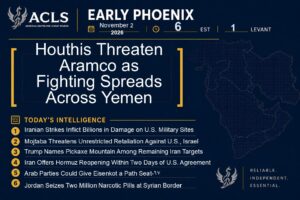
Houthis Threaten Aramco as Fighting Spreads Across Yemen
On November 1, the Saudi-led coalition struck Houthi sites in Dhamar and Hudaydah; Houthi media claimed a strike on Bajil’s oil station wounded three civilians, which remains unverified. The coalition intercepted a ballistic missile and drone aimed at southern Saudi Arabia; alerts in Abha and Khamis Mushait ended without reported damage. Houthis threatened Aramco and warned airlines away from Saudi airspace except over Mecca and Medina; Akasa suspended Riyadh flights through November 30. ISW reported a Houthi advance in Lahij that could threaten Aden. Yemeni forces said they repelled Houthi pushes in al-Jawf and downed two drones near Taiz; AFP reported two missiles targeted Aden’s presidential palace on October 30. The UN says renewed fighting since July has killed more than 1,600.
Iranian Strikes Inflict Billions in Damage on U.S. Military Sites
An AP satellite analysis found that Iranian or Iran-backed strikes hit 26 sites hosting U.S. military equipment through August, causing billions of dollars in damage in more than 115 attacks. Kuwait was hardest hit; Ali Al Salem Air Base was struck at least 30 times. Two U.S. officials said Washington moved assets out of affected locations. UAE adviser Anwar Gargash opposed renewed war, saying Gulf states defended themselves separately and urging diplomacy; Saudi and Bahraini officials also called for de-escalation. Qatar said LNG carrier Al Mayeda was hit by unidentified objects on October 30, without injuries or pollution; Doha condemned the attack on November 1 but named no perpetrator.
PEC+ Holds December Targets Despite Gulf Export Disruptions
Saudi Arabia, Russia, Iraq, Kuwait, Kazakhstan, Algeria and Oman kept December required production at September levels for a third straight month. Targets include Iraq at 4.431 million barrels per day, Kuwait at 2.676 million, and Oman at 841,000; these are quotas, not actual output. The UAE is not a participant after leaving OPEC+ on May 1. OPEC set the next review for November 29. Most members are pumping below target as war-related export disruptions constrain Gulf shipments, and the decision makes no additional supply adjustment.
=================
★ IRAN
Mojtaba Threatens Unrestricted Retaliation Against U.S., Israel
After his first reported meeting with senior commanders, Mojtaba Khamenei ordered an immediate, unrestricted response to any attack, extending Iran’s target list to all tangible and intangible U.S. and Israeli assets. Mohsen Rezaei said Tehran is debating whether to retain its nuclear doctrine if war resumes, has not answered Vance’s letter, and conditions diplomacy on seven Iranian demands. Tehran also designated the Royal Navy and RAF terrorist organizations and MI6 a “hostile group,” effective November 1, citing British support for U.S.-Israeli operations and the UK’s July 13 IRGC listing under the State Threats Act.
Trump Names Pickaxe Mountain Among Remaining Iran Targets
President Donald Trump said October 31 that one or two Iranian sites remained to be addressed, naming Pickaxe Mountain near Natanz and saying the United States could strike it in ten minutes. He said talks were going well, but Iran was unreliable. Iran denies nuclear work at the site; Secretary of State Marco Rubio said no strike decision had been made. Axios reported Prime Minister Benjamin Netanyahu was pressing Trump to strike immediately after the U.S. midterms. Trump has threatened the site since July; its function remains unverified, and the decision window identified in the reporting opens after November 3.
Iran Offers Hormuz Reopening Within Two Days of U.S. Agreement
On November 1, Iranian negotiators entered a third day of Qatari-mediated Doha talks. Araghchi said Iran could reopen Hormuz within two days of an agreement, conditional on U.S. sanctions and blockade relief; no direct U.S. meeting was planned. The IRGC said two tankers struck mines on an “unauthorized route.” UKMTO reported a merchant vessel hit by an unknown projectile; whether the incidents overlap is unconfirmed. CENTCOM says the U.S.-backed southern route is mine-free. UKMTO’s verified list omits most Iranian mine claims but records more than 30 attacks in October, the war’s highest monthly total. No reopening agreement has been reached.
=================
★ ISRAEL AND THE PALESTINIAN TERRITORIES
Arab Parties Could Give Eisenkot a 67-Seat Path
Final results gave Benjamin Netanyahu’s bloc 53 Knesset seats, Gadi Eisenkot’s opposition bloc 48 and Arab-led parties 19. The Joint List and Ra’am are expected to recommend Eisenkot to President Isaac Herzog, potentially giving the opposition a 67-seat parliamentary majority if the blocs cooperate. Eisenkot’s coalition conditions are not expected to satisfy the Arab parties, and recommendations do not guarantee a coalition. Herzog urged flexibility; formal consultations follow presentation of certified results on November 4.
Israeli Strikes Kill Eight in Gaza, Five Police
Israeli strikes killed at least eight Palestinians on November 1: three in Gaza City and five police officers in western Khan Younis, according to medics and Gaza’s Hamas-run interior ministry. Israel’s military said it struck several militants in Khan Younis but did not comment on the Gaza City strike. Israel says Hamas is rearming and violating the ceasefire; Hamas denies it. Disagreement over disarmament and Israeli withdrawal continues to stall the U.S.-brokered ceasefire’s reconstruction and governance arrangements.
Hebron Siege Enters Tenth Day as Settler Attacks Rise
Israeli forces kept Hebron under lockdown for a tenth day on November 1, following an October 23 attack that killed two Israeli soldiers. The municipality said more than 3,300 Palestinians were displaced or affected, 15 homes demolished and 327 businesses closed; about 80,000 students missed school, with daily economic losses exceeding 12 million shekels ($3.8 million). Separately, OCHA’s latest primary report recorded 272 olive-harvest-related settler attacks from September 1–October 19, injuring 200 Palestinians and damaging more than 3,200 trees, exceeding the totals for the entire 2024 and 2025 harvest seasons.
=================
★ LEBANON
Lebanese Court Charges 13 in Hezbollah Explosives Case
A Lebanese military court charged 13 people over a seized truck carrying 780 kilograms of explosives, including TNT and C-4, according to state media and judicial officials. Two defendants remain in custody; 11 were charged in absentia. Hezbollah acknowledged owning the shipment, said it was intended for use against Israeli forces, and sought its return. The case tests Beirut’s effort to bring weapons and armed activity under state authority
=================
★ JORDAN
Jordan Seizes Two Million Narcotic Pills at Syrian Border
Jordan’s Public Security Directorate said November 1 that officers seized two million narcotic pills concealed in a truck’s chassis at the Jaber crossing with Syria; the occupants were detained. Separately, Jordan’s army withdrew a statement reporting 14 armed people attempting to cross from Syria after a direct border engagement. Syrian Foreign Minister Asaad al-Shaibani said no clash had occurred, describing the initial account as a hasty assessment. The seizure is an official claim; the border account remains disputed.
=================
★ SYRIA
Shaibani Says Israeli Demands Block Syria Security Deal
Syrian Foreign Minister Asaad al-Shaibani said Israeli demands are blocking a security agreement and called Israel’s post-December 8, 2024 territorial gains illegitimate, while thanking U.S. envoy Tom Barrack for Washington’s role. Separately, U.S. Assistant Secretary of State Donald Blome said Syria and Lebanon were turning toward reconstruction, presenting sanctions relief as a catalyst and citing the World Bank’s $216 billion estimate of Syria’s reconstruction needs.
=================
★ EGYPT
Egypt Warns Renewed Iran War Would Be More Destructive
Foreign Minister Badr Abdelatty warned at the October 31 Manama Dialogue that U.S.-Iran escalation would be more dangerous and destructive, and said Gulf security is integral to Egypt’s national security. He condemned attacks on Gulf states, warned of disruption to food and energy supply chains, and met Yemen’s foreign minister to discuss Red Sea maritime security. Cairo is signaling solidarity with Gulf partners while emphasizing de-escalation and diplomacy.
=================
★ Disclaimer: This publication is a digest of various news sources compiled by the Early Phoenix team and edited by Rania Kisar. The items are curated, concise summaries of news items hyperlinked within each story. The items and summaries presented do not necessarily represent the views of the American Center for Levant Studies.