

★ IRAN
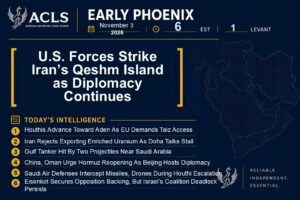
U.S. Forces Strike Iran’s Qeshm Island as Diplomacy Continues
U.S. forces carried out limited strikes on Iran’s Qeshm Island on November 2, three U.S. officials told CNN. Officials called the operation defensive and said it followed Iranian fire at an American aircraft. The Associated Press separately reported strikes against Iranian targets in the Strait of Hormuz. Neither independently verified damage nor casualty figures were available. The operation occurred while Qatar-mediated contacts between Washington and Tehran continued.
Gulf Tanker Hit By Two Projectiles Near Saudi Arabia
A tanker traveling southeast through the Persian Gulf was struck by two unidentified projectiles on its port side, the UK Maritime Trade Operations agency reported on November 2. The incident occurred late on November 1, approximately 72 nautical miles east of Saudi Arabia’s Ras al-Khafji. All crew were accounted for, and no environmental damage was initially reported. UKMTO did not identify the attacker or vessel; the incident highlights shipping risks beyond the Hormuz chokepoint.
Iran Rejects Exporting Enriched Uranium As Doha Talks Stall
Iranian negotiators left talks with Qatari mediators on November 1 as a draft U.S.–Iran proposal circulated, an official briefed on the discussions told Reuters on November 2. Tehran said indirect contacts continued without a breakthrough and linked progress to reopening Hormuz and ending the U.S. naval blockade. Separately, Foreign Ministry spokesman Esmaeil Baghaei told Tasnim that Iran would not transfer enriched uranium abroad. His statement sets out a public negotiating position; neither the draft’s terms nor a next meeting date were confirmed.
China, Oman Urge Hormuz Reopening As Beijing Hosts Diplomacy
China and Oman called for safe navigation through Hormuz, renewed U.S.–Iran negotiations and a return to the Islamabad Memorandum of Understanding in a November 2 joint statement following Sultan Haitham’s Beijing visit. Separately, Chinese Foreign Minister Wang Yi met Iranian security official Ali Bagheri Kani and Saudi adviser Musaed al-Aiban, who delivered a letter from Crown Prince Mohammed bin Salman to Xi Jinping. No joint Iranian-Saudi negotiation or accepted peace plan was announced.
=================
★ARABIAN PENINSULA
Houthis Advance Toward Aden As EU Demands Taiz Access
Houthi forces advanced to within roughly 80 kilometers of Aden, four military sources told Reuters on November 2. The sources said Houthi forces captured Al-Maqatirah district and threatened the Aden–Taiz road; territorial control remains unconfirmed independently. The European Union condemned the escalation and called for urgent humanitarian access to Taiz, where it estimates 800,000–950,000 civilians, and for the release of 70 detained UN staff. The EU also cited attacks on Saudi Arabia and Aden’s Al-Maashiq palace.
Saudi Air Defenses Intercept Missiles, Drones During Houthi Escalation
Saudi-led coalition officials said they intercepted a Houthi ballistic missile headed toward southern Saudi Arabia and destroyed two drones over the Riyadh region on November 2. The coalition did not identify who launched the drones. Houthi spokesman Yahya Saree separately claimed strikes on Dammam airport and facilities near Jazan, but Saudi authorities did not corroborate those claims.
Oil Prices Drop Seven Percent On Iran Diplomacy Hopes
Brent crude fell 7.63 percent on November 2 to settle at $104.77 a barrel, while U.S. West Texas Intermediate lost 7.36 percent to $96.46, Reuters reported. Traders cited renewed hopes for an agreement following Iranian contacts with Qatari mediators. The market reaction reflects expectations of reduced supply disruption, not confirmation of a diplomatic breakthrough. Military activity and threats to shipping continued during the same period.
=================
★ ISRAEL
Eisenkot Secures Opposition Backing, But Israel’s Coalition Deadlock Persists
Israeli opposition parties said on November 2 that they would recommend Gadi Eisenkot to President Isaac Herzog to form the next government. Avigdor Liberman joined that backing but ruled out a minority government dependent on Arab lawmakers, complicating an anti-Netanyahu majority. Final election results gave Netanyahu-aligned parties 53 seats, the Jewish-led opposition 48, and Arab parties 19. Herzog was due to receive recommendations after the results were formally presented.
=================
★ Disclaimer: This publication is a digest of various news sources compiled by the Early Phoenix team and edited by Rania Kisar. The items are curated, concise summaries of news items hyperlinked within each story. The items and summaries presented do not necessarily represent the views of the American Center for Levant Studies.