

★ IRAN
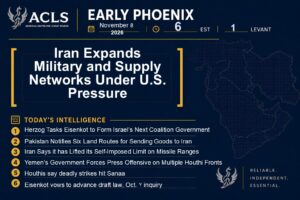
Iran Expands Military and Supply Networks Under U.S. Pressure
The IRGC says it has lifted its self-imposed 2,000-kilometer cap on ballistic-missile range and plans to unveil an underground missile city; AP notes Iran is not known to possess missiles exceeding that range. BBC Verify identified new construction at Garmdareh and Shahroud missile sites and repairs at 12 other military installations. A Reuters investigation traced military imports through Russian Caspian shipping, Central Asian trucks and Chinese air cargo to more than 5,000 Defense Ministry-linked agencies. One, MOD 346428, accounted for $2.3 billion in imports; 97% of reviewed transactions involved no cross-border currency transfer. Pakistan designated six land routes for goods entering Iran; active Caspian general-cargo vessels rose from 105 to 215 between February and August. On November 7, CENTCOM established Task Force Iron Gate to disrupt weapons, dual-use technology, sanctioned materials and illicit revenue moving across Iran’s land borders and the Caspian. U.S. forces disabled the St. Kitts-flagged M/V Huda after it allegedly attempted to breach the naval blockade. Treasury sanctioned eight Canadian money-services businesses over alleged Iran-linked transactions, in coordination with FINTRAC.
=================
★ ISRAEL & PALESTINIAN TERRITORIES
Herzog Tasks Eisenkot to Form Israel’s Next Coalition Government
President Isaac Herzog has tasked former military chief Gadi Eisenkot, leader of Yashar, with forming Israel’s next government after 67 lawmakers recommended him, compared with 46 for Benjamin Netanyahu. Eisenkot has 28 days, with a possible 14-day extension, to secure a governing majority of 61 in the 120-seat Knesset. His four-party bloc holds 48 seats; two Arab-led parties hold 19 and backed his bid, but several prospective partners oppose relying on their support. Netanyahu’s bloc holds 53 seats, and he has called for a national unity government that includes his existing allies. Eisenkot’s camp is preparing to replace Knesset Speaker Amir Ohana and use its parliamentary majority to advance a state commission of inquiry into the October 7 attacks, repeal parts of Netanyahu’s judicial overhaul and introduce mandatory military or national service. Coalition talks also face disputes over exemptions for ultra-Orthodox men.
=================
★ ARABIAN PENINSULA
Yemen’s Government Forces Press Offensive on Multiple Houthi Fronts
Yemen’s internationally recognized government is pressing Operation Dawn of Yemen, launched in October, against Houthi positions across Taiz, Lahij, Marib and Al-Jawf. Government forces report repelling attacks near Al-Kamb and Al-Aqroud, striking positions and reinforcements in Al-Misrakh, and retaking positions in Al-Maqatirah and strategic heights east of Al-Hazm. The Houthis say they have thwarted advances in Al-Jawf and Marib. Fighting also continues along the Bab al-Mandeb front. On November 6, Yemen’s government accused the Houthis of firing a ballistic missile at Taiz’s Al-Hadara market; the Houthis blamed Saudi airstrikes. The Houthis separately claimed six missile and drone attacks on Saudi targets; the Saudi-led coalition said it intercepted a ballistic missile over Riyadh. IOM recorded 308,653 people displaced between August 1 and November 3, including 135,648 in Taiz, 77,052 in Lahij and 58,884 in Aden. A month-long Houthi siege has restricted food, fuel, and medical deliveries to Taiz; the governor says 120 health centers have stopped operating and hospitals are at 20% capacity.
=================
★ Disclaimer: This publication is a digest of various news sources compiled by the Early Phoenix team and edited by Rania Kisar. The items are curated, concise summaries of news items hyperlinked within each story. The items and summaries presented do not necessarily represent the views of the American Center for Levant Studies.