

★ IRAN
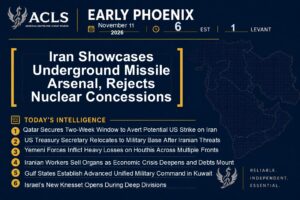
Iran Showcases Underground Missile Arsenal, Rejects Nuclear Concessions
Iran’s Revolutionary Guard unveiled an underground missile facility displaying ballistic and cruise missiles, claiming its arsenal and production capabilities remain operational despite US and Israeli strikes. Armed Forces Chief Ali Abdollahi warned that further attacks would trigger retaliation beyond the Middle East. Security official Mohsen Rezaei vowed to retain all enriched uranium and target distant US bases if attacked again, and denied ongoing negotiations. At the same time, Foreign Minister Abbas Araghchi condemned Washington’s $20 million reward for nuclear programme information.
US Treasury Secretary Relocates to Military Base After Iranian Threats
US Treasury Secretary Scott Bessent has relocated from his Washington residence to a military base following Iranian threats against his life, Reuters reported. Bessent has led Washington’s sanctions campaign against Tehran, known as Operation Economic Outcast, alongside a naval blockade of Iranian ports. The Treasury said he remains committed to maintaining pressure on Iran.
Iranian Workers Sell Organs as Economic Crisis Deepens and Debts Mount
Workers in Tehran are advertising kidneys, liver tissue and bone marrow for sale to repay debts and cover living costs, ILNA reported. Kidney prices range from 8 billion to 50 billion rials, while minimum-wage earnings fall far short of basic household expenses. A parliamentary official said eight million Iranians face absolute poverty and malnutrition.
Iran’s Oil Reserves Depleted as US Blockade Threatens December Revenues
Iran has exhausted nearly 88 million barrels of floating oil stocks, raising the risk of crude and condensate revenues drying up by mid-December if the US blockade continues. Another 43 million barrels remain trapped, while oil accounts for 30–40% of government revenue. The rial has lost 35% of its value since July, with inflation reaching 88.7% in October.
Canada Reimposes Sanctions on Eleven Iranian Nuclear and Missile Entities
Canada reinstated sanctions on 11 Iranian entities accused of supporting its nuclear activities, ballistic missile program and related financing. Announced by Foreign Minister Anita Anand at the G7 meeting in Paris, the measures target nuclear fuel companies, oil firms, banks and insurers. Ottawa cited Iran’s repeated failure to cooperate with the IAEA.
=================
★ ARABIAN PENINSULA
Qatar Secures Two-Week Window to Avert Potential US Strike on Iran
Qatar secured at least two weeks to pursue diplomacy aimed at preventing a US strike on Iran, Prime Minister Sheikh Mohammed bin Abdulrahman Al Thani told G7 foreign ministers in Paris. Significant gaps remain over the sequencing of a potential deal, including lifting the naval blockade, addressing Iran’s nuclear program and unfreezing Iranian assets.
Gulf States Establish Advanced Unified Military Command in Kuwait
GCC defense ministers approved establishing an advanced headquarters for the Unified Military Command in Kuwait, allocating forces to support its operations. The decision, adopted during their 23rd Joint Defense Council meeting in Manama on November 10, aims to strengthen military integration and coordination amid regional threats. GCC officials condemned Iranian attacks and Houthi strikes against Saudi Arabia, reaffirming collective Gulf security commitments.
Yemeni Forces Inflict Heavy Losses on Houthis Across Multiple Fronts
Yemeni government forces continued clashes with Houthi militias across Jawf, Marib and Al-Bayda, targeting their positions and movements. Military spokesman Colonel Majed Abdullah Al-Nuzaili reported around 190 Houthi fighters killed or wounded and 130 military vehicles and combat assets destroyed or damaged.
=================
★ ISRAEL
Israel’s New Knesset Opens During Deep Divisions and Anti-Arab Attacks
Israel’s new Knesset opened Tuesday amid sharp political divisions, with President Isaac Herzog urging unity and warning against repeat elections. Prime Minister-designate Gadi Eisenkot introduced legislation for an official investigation into the October 7 attacks, while Benjamin Netanyahu attacked Arab parties, accusing them of seeking to destroy Israel after winning a historic 19 seats.
Netanyahu Forms Secret Team to Block Eisenkot’s Government Bid
Benjamin Netanyahu assembled a small political team to disrupt opposition negotiations and prevent ultra-Orthodox parties from joining a potential government led by Gadi Eisenkot. The effort focuses on internal divisions within United Torah Judaism and negotiations over military conscription exemptions, as Eisenkot’s 48-seat bloc seeks the 61 seats needed for a parliamentary majority.
=================
★ Disclaimer: This publication is a digest of various news sources compiled by the Early Phoenix team and edited by Rania Kisar. The items are curated, concise summaries of news items hyperlinked within each story. The items and summaries presented do not necessarily represent the views of the American Center for Levant Studies.