★IRAN
-
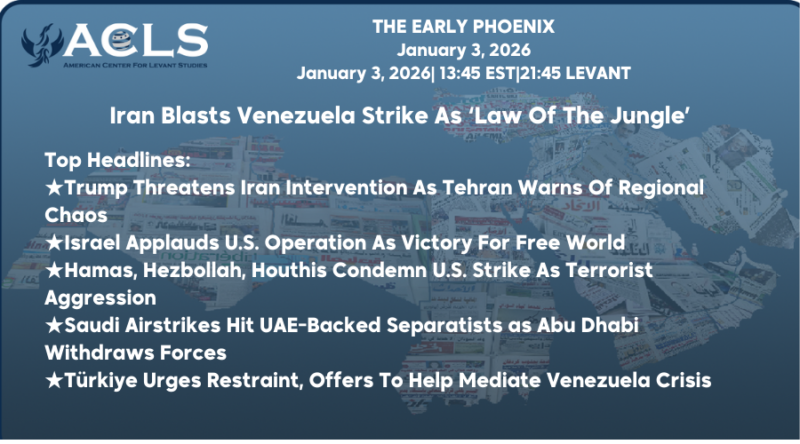
Iran Blasts Venezuela Strike As ‘Law Of The Jungle’
Tehran issued the region’s strongest condemnation, calling the operation a “flagrant” breach of international law that fuels global instability. An editorial in the Tehran Times brands the strike and reported abduction of Nicolás Maduro as illegal “law of the jungle,” accusing Washington of bypassing international law to impose regime change, seize Venezuelan oil, revive a Monroe Doctrine–style hegemony, and repeat interventions seen in Panama, Grenada, and Iraq while urging Latin American states to resist U.S. domination. An IranWire feature describes Venezuela as a “true friend and ally” in Iran’s “axis of resistance,” citing President Pezeshkian’s pledge to back Caracas “under any circumstances,” expanding multi‑billion‑dollar trade, oil‑for‑gold deals, and reported drone cooperation, and relaying Iranian officials’ claims that U.S. moves in the Caribbean amount to “international bullying,” UN Charter violations, and foreign‑backed pressure aided by opposition leader María Corina Machado. Tasnim’s coverage of the Foreign Ministry statement denounces the attack as a “blatant” and “flagrant” violation of Venezuela’s sovereignty and territorial integrity, a clear breach of Article 2(4) of the UN Charter and an “aggressive action,” urging states and the UN to condemn it, affirming Venezuela’s right to self‑defense and self‑determination, and demanding accountability for alleged crimes in strikes on civilian and military sites in Caracas, Miranda, Aragua, and La Guaira.
-
Iran Protesters Killed As Khamenei Orders Ruthless Crackdown
The Iranian regime faces its worst unrest since 2022, driven by a sharp currency fall and an escalating water crisis that has left key reservoirs around Tehran at record lows and pushed per‑capita supplies in the capital toward severe‑stress levels. The sharp depreciation paralyzed Tehran’s Grand Bazaar and nearby commercial hubs, where shopkeepers shuttered businesses and protested, demanding urgent government intervention to halt the economic collapse.
Security forces deployed tear gas to disperse demonstrators chanting anti-government slogans. Seeking to contain the fallout, authorities replaced the central bank governor and threatened harsh legal action against currency speculators, but the unrest continued to spread. Clashes between demonstrators and security forces led to arrests, injuries, and limited property damage, with security units reportedly using live ammunition in several locations. Reports indicated at least ten fatalities after an initial six deaths in the first 48 hours of unrest.
Ayatollah Khamenei has publicly branded protesters “rioters” and “enemy mercenaries” who “must be put in their place,” explicitly backing a firm crackdown. At the same time, President Pezeshkian and parts of the civilian government stress protesters’ ‘right to protest’ and signal willingness to negotiate.
The demonstrations expanded and developed after President Trump issued a stern warning to the Iranian regime stating that Washington is “locked and loaded” to intervene if the killing of peaceful protestors continue, pledging that the United States would “come to their rescue.”
Iranian officials warned that Trump’s remarks were “provocative” and risked undermining peace and stability across the entire region, implying that any U.S. move could trigger wider escalation. Iran also filed a complaint at the UNSC accusing Washington of provoking more demonstrations.
By the sixth day of protests, funeral processions for slain demonstrators had turned into mass rallies, with mourners chanting for the fall of the regime. Protests were reported in more than 20 cities as security measures tightened further. Human rights investigations documented a sharp escalation in force, with at least 44 protesters wounded by live ammunition or shotgun pellets, including teenagers and students, and dozens more beaten by security personnel. Some of the injured were reportedly arrested inside hospitals amid a broader crackdown involving numerous detentions.
Venezuela, meanwhile, had declared “unwavering solidarity” with Iran before the U.S. operation, denouncing Washington’s threats as escalatory, contrary to the UN Charter, and a danger to regional and international peace, while urging respect for Iran’s sovereignty and rejection of foreign interference in its internal affairs.
===========
★ ISRAEL
-
Israel Applauds U.S. Operation As Victory For Free World
Foreign Minister Gideon Sa’ar publicly congratulated the United States, stating Israel “stands alongside the freedom-loving Venezuelan people who have suffered under illegal tyranny.” Sa’ar welcomed the removal of a “dictator leading a network of drugs and terror” and expressed hope for restoring diplomatic ties. Simultaneously, opposition leader Yair Lapid explicitly linked the strike to Iran, warning Tehran to “pay close attention” to the operation, while Prime Minister Netanyahu framed it as a restored deterrent against anti-American regimes.
-
Hamas Condemns Venezuela Strikes, Urges International Counteraction
Islamic Resistance Movement Hamas condemned what it termed American military aggression against Venezuela, describing the reported kidnapping of President Nicolás Maduro and his wife as a flagrant breach of international law and an assault on the sovereignty of an independent state that threatens broader international stability. The movement framed the operation as part of long-standing unjust US policies and interventions driven by imperial ambitions that, it alleges, fuel internal conflicts and undermine international peace and security, and it urged the United Nations, especially the Security Council, to act immediately to stop the attacks on Venezuelan territory and enforce the red line of state sovereignty and adherence to international law.
=========
★ LEBANON
-
Hezbollah Condemns U.S. Strike As Terrorist Aggression
Hezbollah issued a forceful statement denouncing the U.S. operation as “terrorist aggression and American thuggery” against Venezuela. The group framed the capture of President Maduro as a “blatant and unprecedented violation” of national sovereignty that threatens all independent states opposing U.S. hegemony. Asserting full solidarity with Caracas, Hezbollah warned that such “arrogance” reveals Washington’s criminal nature, drawing direct parallels to U.S. actions in Iraq, Yemen, and against the “Resistance Axis” in the Middle East.
=========
★YEMEN
-
The Houthis Condemns U.S. Attack As Barbaric Global ‘Evil’
Yemen’s Ansar Allah political bureau condemned the U.S. military attack on Venezuela as a “barbaric escalation,” saying Washington’s strikes and ongoing blockade reflect American “savagery and criminality” and a policy of destroying nations, killing people, and looting resources. It declared full solidarity with Venezuela and President Nicolás Maduro, affirmed Caracas’s “full right” to defend its sovereignty, people, and wealth, and urged the international community to act immediately to halt U.S. aggression and uphold international law.
-
Saudi Pressure Forces UAE Military Exit From Yemen
Saudi Arabia effectively forced the UAE’s military out of Yemen after a sharp escalation over Emirati support for southern separatists, marking the most serious rupture inside the anti‑Houthi camp to date. Riyadh backed Yemen’s Presidential Leadership Council as it tore up a defense pact with Abu Dhabi, ordered Emirati forces to withdraw within 24 hours, and tightened control over airspace and crossings. Saudi jets then struck a suspected UAE weapons shipment to separatists in Mukalla, denouncing the move as a direct threat to Saudi security, before Abu Dhabi announced it would pull all remaining “counterterrorism” troops and later confirmed every unit had left Yemeni soil. Emirati officials insist the withdrawal was a sovereign, pre‑planned decision, but regional and Western reporting widely link the timing to Saudi military pressure and the ultimatum.
==========
★ TURKIYE
-
Türkiye Urges Restraint, Offers To Help Mediate Venezuela Crisis
The Turkish Foreign Ministry urged all parties to exercise restraint to prevent “negative consequences for regional and international security” following the U.S. strikes. Ankara emphasized the importance of Venezuela’s stability and the “peace and well-being” of its people, expressing readiness to facilitate a resolution within international law. However, presidential advisors voiced sharper criticism, with senior aides condemning the operation as “imperial banditry” and signaling solidarity with Caracas despite the Foreign Ministry’s more measured diplomatic tone.
=========
★ Disclaimer: This publication is a digest of various news sources compiled by the Early Phoenix team and edited by Rania Kisar. The items are curated, concise summaries of news items hyperlinked within each story. The items and summaries presented do not necessarily represent the views of the American Center for Levant Studies.