★IRAN
-
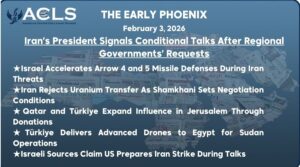
Iran’s President Signals Conditional Negotiations Following Regional Governments’ Requests
Iranian President Masoud Pezeshkian said he instructed the foreign minister to pursue negotiations, responding to a proposal from the President of the United States, following requests from friendly regional governments. Pezeshkian stated talks would proceed only if conditions are free from threats and unreasonable expectations and conducted within Iran’s national interests, dignity, prudence, and expediency.
-
Iran Rejects Uranium Transfer As Shamkhani Sets Negotiation Conditions
Iran has refused to transfer enriched uranium outside the country, with Supreme Leader adviser Ali Shamkhani stating there is “no reason” to remove nuclear material abroad, according to an Al-Mayadeen interview. Shamkhani said Iran may reduce enrichment levels domestically under supervision but ruled out export, citing the Supreme Leader’s fatwa banning nuclear weapons. He said negotiations with the United States are possible only on the nuclear issue and only if talks are free from threats and unreasonable demands.
-
Israeli Sources Claim US Prepares Iran Strike During Talks
Israeli sources report that the United States is seriously preparing for a massive military attack on Iran while negotiations are discussed. Separately, Reuters reported, citing current and former officials, that Iranian leaders are concerned a potential U.S. strike could reignite domestic unrest and threaten regime stability following January protest crackdowns.
-
UK Sanctions Iranian Officials Over Deadly Protests
Britain imposed sanctions on 10 Iranian individuals and a state security body for human rights violations during recent peaceful protests, including suppression of expression, assembly, and breaches of the right to life. Measures include asset freezes, travel bans, and director disqualifications, following similar EU and U.S. sanctions during rising international pressure on Tehran.
-
Massive Fire Erupts in Tehran Market, Cause Unknown
A large fire broke out Saturday in a Tehran market at the Niayesh and Jenat Abad intersection, covering a 2,000-square-meter area with multiple stalls. Five fire stations responded with vehicles, water trucks, and oxygen cylinders. Authorities reported no casualties yet, and firefighting efforts are ongoing during rising tensions between Tehran and Washington.
=========
★ISRAEL
-
Hamas Plans Covert Gaza Control Despite Ceasefire Agreement
A leaked Hamas document reveals plans to secretly maintain administrative control of Gaza, instructing officials to operate discreetly without alerting the incoming NCAG, forbidding attacks on its members, and restricting outside communication, while NCAG prepares to assume governance and unveils a new logo featuring Palestinian Authority symbols.
-
Gaza Committee Adopts PA Logo, Sparking Israeli Backlash
Israel expressed strong opposition after Gaza’s technocratic committee, the NCAG, replaced its original logo with one nearly identical to the Palestinian Authority’s eagle emblem. Prime Minister Netanyahu’s office insisted the PA would not participate in Gaza’s administration, despite many NCAG members having PA ties. The move appears intended to link the committee to the PA, heightening tensions over postwar governance in Gaza.
-
Abbas Sets November 1 Date for Palestinian National Council Elections
Palestinian Authority President Mahmoud Abbas announced that the Palestinian National Council will hold elections on November 1, the first to allow voting rather than appointments. He confirmed voting will occur inside and outside Palestine, while also setting Fatah’s Eighth General Conference for May 14, 2026, and local West Bank elections for April 25, 2026, banning Hamas from participating.
-
Israel Accelerates Arrow 4 and 5 Missile Defenses During Iran Threats
Israel has fast-tracked development of its next-generation Arrow missile defenses, with Arrow 4 in advanced stages and Arrow 5 in R&D, designed to counter Iranian hypersonic missiles and decoys. Brig. Gen. (ret.) Daniel Gold highlighted Israel’s high interception rates during recent Iranian attacks, while U.S. THAAD support and ongoing system adaptations reinforce a multi-layered defense architecture against evolving threats.
=========
★AFRICA
-
Türkiye Delivers Advanced Drones to Egypt for Sudan Operations
Türkiye has delivered advanced Bayraktar Akinci combat drones to Egypt, which deployed them at a southern airbase to support operations linked to Sudan’s civil war, signaling a deeper Egyptian military role against the RSF following its advances in Darfur near Egypt’s border.
-
Sudanese Army Breaks Siege on Strategic Kadugli
Sudanese forces lifted a long-standing siege by the Rapid Support Forces on Kadugli, the capital of South Kordofan, on Tuesday, according to military sources. The city, facing severe humanitarian conditions and famine threats, had been blockaded since the conflict between the army and RSF began in April 2023.
=========
★THE GULF
-
Qatar and Türkiye Expand Influence in Jerusalem Through Donations
Qatar and Türkiye are gaining a foothold in Jerusalem via major donations, including $7 million from the Qatar Fund for Development to St. Joseph’s Hospital, while Turkish cultural and aid bodies operate nearby. Though hospital officials insist the funds are non-political, Christian leaders warn these contributions risk increasing Islamic influence over key institutions in the city.
-
Saudi-Houthi Understandings Secure Yemen-Saudi Border
Following the withdrawal of UAE-linked and Southern Transitional Council forces, the Houthis have filled the security vacuum along the Yemen-Saudi border under secret agreements with Riyadh. The arrangements include logistical support from Saudi Arabia, coordination with Yemen’s internationally recognized government, and potential implications for regional issues like Sudan and Red Sea maritime security.
=========
★ Disclaimer: This publication is a digest of various news sources compiled by the Early Phoenix team and edited by Rania Kisar. The items are curated, concise summaries of news items hyperlinked within each story. The items and summaries presented do not necessarily represent the views of the American Center for Levant Studies.