

★LEBANON
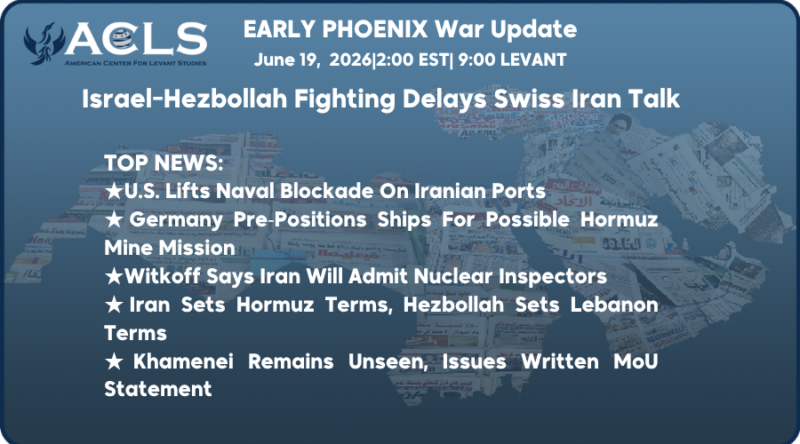
Israel-Hezbollah Fighting Delays Swiss Iran Talks
The IDF continued operations near Arnoun and Kfar Tibnit, where clashes and drone strikes killed several people despite the new U.S.–Iran MoU. Hezbollah-linked and regional outlets reported that Iran’s delegation then delayed its departure for Switzerland over these strikes. Shortly after, the White House said Vice President JD Vance also postponed his trip, citing logistical issues but stressing both sides still intend to begin technical talks within days. Lebanese TV and local outlets later reported fresh Israeli air and drone strikes on villages around Nabatieh, including areas near Doueir, triggering renewed displacement from southern Lebanon.
Israel Widens Lebanon Zone Ahead of June 23 Talks
Israel published an expanded “security zone” map showing its forces operating several kilometers inside southern Lebanon near Nabatieh and signaled it does not feel bound by the U.S.–Iran MoU’s Lebanon clause, with Netanyahu tying any withdrawal to Hezbollah’s disarmament. Lebanon and Israel are meanwhile due to resume U.S.-sponsored talks on June 23 to refine ceasefire terms, border security, and “pilot zones” where the Lebanese army would eventually take exclusive control along the frontier.
US Sanctions Franjieh And Qmati Over Hezbollah Ties
The U.S. Treasury sanctioned Marada Movement leader Suleiman Franjieh and senior Hezbollah official Mahmoud Qmati, accusing them of using their political influence to obstruct Lebanon’s peace process and delay Hezbollah’s disarmament. Treasury alleges Franjieh accepted Hezbollah funding to target reformist MPs, while Qmati coordinates cash transfers from Iran, and says it will keep targeting Hezbollah’s financial networks as it presses for Hezbollah’s disarmament.
Iran Sets Hormuz Terms, Hezbollah Sets Lebanon Terms
Iran’s Supreme National Security Council said commercial vessels can transit the Strait of Hormuz without fees for 60 days under the new U.S.–Iran memorandum, with Iran managing applications, routes, and timing as mine‑clearance and safety measures proceed. In Lebanon, Hezbollah parliamentary bloc chief Mohammad Raad says Israel has the same 60‑day period to end hostilities and withdraw from Lebanese territory, presenting this as required by the memorandum and urging Beirut to rely on indirect rather than direct negotiations.
Lebanon, Israel Blame Each Other For Ceasefire Risk
Lebanese Parliament Speaker Nabih Berri said Lebanon and Hezbollah remain committed to the ceasefire only if Israel “fully and comprehensively” respects it, warning that violations could force Hezbollah to reassess its position. Israeli Ambassador to the U.S. Yechiel Leiter meanwhile said Israel will honor the U.S.-brokered truce as long as Hezbollah fully complies, while reserving Israel’s right to respond to any threat and insisting Hezbollah must be removed from the border area.
===========
★IRAN
U.S. Lifts Naval Blockade On Iranian Ports
U.S. Central Command announced it has fully lifted the naval blockade on shipping to and from Iranian ports and coastal areas, in line with the new U.S.–Iran memorandum of understanding. CENTCOM said American forces are no longer impeding vessel movements but that U.S. warships will remain in regional waters to monitor compliance with the agreement and support reopening of the Strait of Hormuz.
Germany Pre‑Positions Ships For Possible Hormuz Mine Mission
German Defence Minister Boris Pistorius said the minesweeper Fulda and supply ship Mosel are transiting the Suez Canal toward the Red Sea to be pre‑positioned for a potential multinational mine‑clearing mission in the Strait of Hormuz. He stressed that any deployment into Hormuz would require a clear legal mandate, consent from Iran and Oman, and depend on how U.S.–Iran negotiations and the new ceasefire agreement evolve over the coming weeks.
Khamenei Remains Unseen, Issues Written MoU Statement
In a written message attributed to Iran’s Supreme Leader Mojtaba Khamenei, he said he authorized the U.S.–Iran MoU despite holding “a different view,” citing President Masoud Pezeshkian’s pledge to protect Iranian and Resistance Front interests. The statement warned that future direct talks would not mean accepting U.S. positions. Khamenei has not been publicly seen or heard since being wounded in February, according to Israeli reporting.
Pezeshkian Thanks Qatar for De-Escalation Role
Iranian President Masoud Pezeshkian thanked Qatar’s Emir Sheikh Tamim bin Hamad Al Thani for supporting de-escalation after the U.S.–Iran MoU was signed. Qatar’s Amiri Diwan said Sheikh Tamim congratulated Pezeshkian and expressed hope the agreement would strengthen regional and international stability, while Doha reaffirmed its support for dialogue and diplomatic solutions.
Witkoff Says Iran Will Admit Nuclear Inspectors
U.S. envoy Steve Witkoff told lawmakers Iran will invite the IAEA to inspect nuclear facilities, identify enriched uranium locations, and monitor their status under arrangements tied to the U.S.–Iran MoU. AP reported that the inspection mechanism would be organized through a separate Iran-IAEA letter, making access to nuclear sites an early test of Tehran’s compliance during the 60-day negotiation period.
Reuters Says Iran Deal Alarms Regional Rivals
Reuters reported that the U.S.–Iran MoU is being viewed by Israel, Gulf states, and Lebanese factions as a strategic gain for Tehran. Analysts cited by Reuters said the deal could restore Iran’s legitimacy, ease sanctions pressure, reopen oil exports, constrain Israel’s Lebanon campaign, and deepen regional doubts about U.S. reliability while giving Iran time to recover.
==============
★ Disclaimer: This publication is a digest of various news sources compiled by the Early Phoenix team and edited by Rania Kisar. The items are curated, concise summaries of news items hyperlinked within each story. The items and summaries presented do not necessarily represent the views of the American Center for Levant Studies.