

IRAN
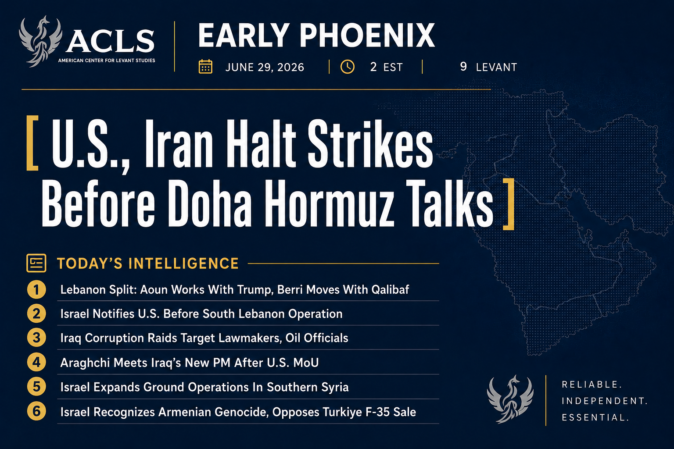
U.S., Iran Halt Strikes Before Doha Hormuz Talks
The United States and Iran agreed to temporarily halt attacks and meet Tuesday in Doha after two nights of strikes, tanker attacks, and warnings over the Strait of Hormuz. Axios cited U.S. officials saying both sides would allow ships to sail freely while technical talks resume, with Al Arabiya reporting the agenda has shifted from Switzerland to Doha and will focus mainly on Hormuz. CENTCOM said it struck Iranian surveillance, communications, air-defense, drone-storage, and minelaying sites after an Iranian drone attack on the Panama-flagged Kiku tanker. Iran claimed retaliatory strikes on U.S. sites in Kuwait and Bahrain, while Gulf states reported countering the attacks. Trump warned Iran could “cease to exist” if war resumed, while Foreign Minister Abbas Araghchi said any separate Hormuz arrangements outside Iran’s role would delay reopening and increase tensions.
Araghchi Meets Iraq’s New PM After U.S. MoU
Iranian Foreign Minister Abbas Araghchi visited Baghdad after the U.S.-Iran MoU and met Iraq’s new prime minister, Ali al-Zaidi, according to Iranian and regional reports citing Iraqi officials. Zaidi said Iraq supports dialogue and diplomacy to end wars and stabilize the region, while the two discussed the MoU, regional stability, sovereignty, and territorial integrity. Araghchi also met Iraqi President Nizar Amedi and Foreign Minister Fuad Hussein. Press TV said the visit was expected to include Iraq’s debt payments to Iran, border security, and measures against anti-Iran groups operating from Iraqi territory.
============
LEBANON
Israel Notifies U.S. Before South Lebanon Operation
Prime Minister Benjamin Netanyahu and Defense Minister Israel Katz said the Israeli army destroyed Hezbollah underground infrastructure in Majdal Zoun, southern Lebanon, after notifying the United States in advance, marking an early test of the U.S.-backed Israel-Lebanon framework. Israeli reports said the tunnel was more than 200 meters long, located near homes, a school, and a mosque, and contained about 50 Iranian UAVs, explosives, and launch infrastructure tied to Hezbollah’s drone network. The announcement came hours after Israel said an officer was killed and a soldier wounded in a clash with a Hezbollah fighter in Deir Seryan. Israel said its forces would remain in the southern “security zone” to remove Hezbollah infrastructure.
Aoun Asks Trump To Press Israel On Withdrawal
Lebanese President Joseph Aoun told President Trump that Lebanon would implement the U.S.-backed Israel-Lebanon framework and asked Washington to prevent violations and press Israel to withdraw from southern Lebanon. Lebanon’s presidency said Aoun told Trump that Israeli withdrawal would allow the Lebanese Army to deploy to the international border. Trump reaffirmed U.S. support for Lebanon’s sovereignty, territorial integrity, and state authority through the armed forces.
Qalibaf Call Precedes Berri Veto Of Lebanon Deal
Following a call from Iranian Parliament Speaker Mohammad Bagher Qalibaf, Lebanese Parliament Speaker Nabih Berri announced that the U.S.-backed Israel-Lebanon agreement would not pass. Al-Manar said Qalibaf and Berri agreed that Israel continues to violate the MoU’s first clause requiring the war to end on all fronts, including Lebanon. Qalibaf said Iran would continue efforts to compel Israel to end its war on Lebanon. Berri reportedly told Qalibaf the “Washington Understanding” was a conspiracy and source of discord. Both called for convening the Conflict Control Unit to control and end the war in Lebanon.
CENTCOM Visit Reported To Advance Lebanon Framework
i24 Arabic, citing LBCI, reported that the CENTCOM commander is expected to visit Lebanon from Israel to discuss implementation mechanisms for the U.S.-backed Israel-Lebanon framework. The report said talks would focus on security provisions and a tripartite committee to oversee field commitments, with no amendments to the agreement’s basic text.
=============
ISRAEL
Israel Expands Ground Operations In Southern Syria
Israeli forces expanded ground operations in southern Syria over the weekend, with Syrian and monitoring sources reporting six incursions in Daraa and Quneitra that included house raids, temporary checkpoints, interrogations, and a brief detention. Israel said its forces killed several people inside its southern Syria “security zone” and would continue operations to remove threats. Syrian outlets later reported Israeli shelling near Abdeen in western Daraa after residents confronted a patrol, prompting limited displacement. Damascus condemned the incursions and shelling as violations of Syrian sovereignty, international law, and the 1974 Disengagement Agreement, and called for U.N. action to halt repeated Israeli operations.
Israel Recognizes Armenian Genocide, Opposes Turkiye F-35 Sale
Israel’s Cabinet unanimously approved recognizing the Armenian genocide, sending the measure to the Knesset and drawing condemnation from Turkiye, which called the move politically motivated and aimed at deflecting from Gaza. Foreign Minister Gideon Sa’ar framed the decision as a moral and historical duty, while Turkiye accused Israel of pursuing destabilizing regional policies. Netanyahu separately said Israel would raise concerns with Washington over any U.S. F-35 sale to Turkiye, citing Erdogan’s threats against Israel. U.S. House lawmakers also urged Rubio and Hegseth to block advanced fighter access for Ankara over its Russian S-400 system and risks to Israel, Greece, and Cyprus.
=============
IRAQ
Iraq Corruption Raids Target Lawmakers, Oil Officials
Iraqi authorities arrested dozens of politicians and senior officials in one of the country’s broadest corruption crackdowns in years, with state media reporting 47 detainees and Shafaq citing a security source saying the number rose to 67. The arrests included sitting lawmakers, senior Oil Ministry figures, and Azm Alliance leader Muthanna al-Samarrai, while the probe stems partly from testimony by former Deputy Oil Minister Adnan al-Jumaili. Iraq’s Integrity Commission said the suspects are accused of misappropriating public funds and that judicial warrants followed months of investigation. Prime Minister Ali al-Zaidi said the campaign is only a first stage, coming weeks before his planned Washington visit and after Iraq was placed on the FATF grey list for money-laundering and financial-crime risks.
================
★ Disclaimer: This publication is a digest of various news sources compiled by the Early Phoenix team and edited by Rania Kisar. The items are curated, concise summaries of news items hyperlinked within each story. The items and summaries presented do not necessarily represent the views of the American Center for Levant Studies.